Introduction: The Reality of the Startup Grind
The popular narrative of the startup world is a sanitized lie. We are sold a romanticized myth of “garage-born” geniuses who, through the sheer force of a singular brilliant idea, watched the world beat a path to their door. This version of the story suggests that if your product is “disruptive” enough, success is a mathematical certainty.
The reality I’ve seen through 17 years of building companies and mentoring founders is a meat-grinder. Most startups don’t fail because the founders lacked vision or the engineering was subpar; they fail because they ignored the cold, unglamorous mechanics of business. Success isn’t about “innovation” buzzwords—it’s about the scar tissue earned from confronting hard truths that most founders are too proud to admit.
If you want to survive, you have to trade your idealism for a lean, pragmatic mindset. The following insights are the counter-intuitive “hard truths” that separate the survivors from the statistics.
Takeaway 1: The Distribution Trap (Why Great Products Fail)
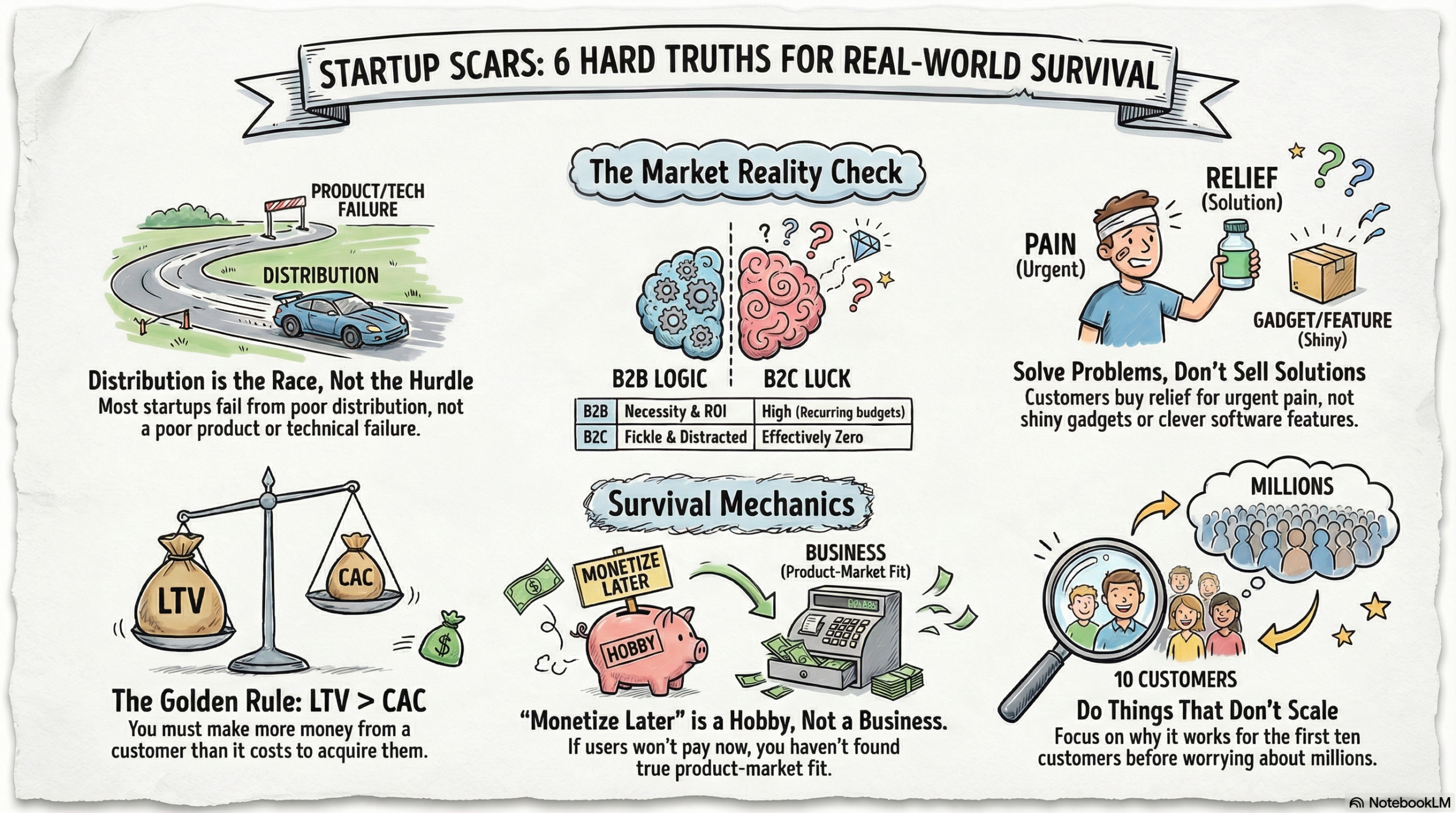
There is a persistent, deadly fallacy in the startup world: “if you build it, they will come.” This mindset assumes the market is a meritocracy where the best product naturally wins. In the real world, the most frequent cause of death is not a technical failure, but a failure to reach the customer.
“You will probably fail from poor distribution, not poor product.”
Founders habitually over-index on features, hallucinating that one more “cool” function will finally trigger a wave of users. They are wrong. If you just build it, they will not come. Without a ruthless strategy for how people will discover and access the product, even a perfect solution will rot in obscurity. Distribution isn’t the secondary hurdle; it is the race.
Takeaway 2: The B2B Advantage
While many founders chase the dream of building the next viral consumer sensation, the B2C market is a graveyard. Building a B2B (Business-to-Business) company is objectively “easier” because it relies on logic rather than luck.
Businesses operate on necessity and recurring needs, and they are accustomed to paying for tools that improve their bottom line. Most importantly, in B2B, the person using the product often isn’t the one paying for it—you are selling an ROI calculation to a department head, not competing for a fickle consumer’s dopamine hit. A business has a budget; a consumer has a thousand distractions.
Takeaway 3: The “Monetize Later” Myth
The most common mask for a lack of product-market fit is the promise to figure out revenue once the user base is large enough.
“‘We will monetise it later’ isn’t a viable business model.”
If people are using your product for free but refuse to pay for it, you haven’t built a business; you’ve built a hobby. Delaying monetization is usually a sign of cowardice—the founder is afraid to find out that the market doesn’t actually value the “solution.” A viable model must be baked into the project from day one, not tacked on as a desperate afterthought once the VC money dries up.
Takeaway 4: Mobile App Fatigue
The era of “there’s an app for that” ended years ago. Today, nobody wants another mobile app. The friction involved in finding an app, downloading it, and managing yet another set of notifications is a massive barrier to entry. In a crowded digital landscape, asking a user to install new software is a “hard sell” that most startups lose. If your business requires a download to provide value, you’ve already created a reason for the customer to say no.
Takeaway 5: The Funding Reality Check
Founders often mistake a conceptual idea for a fundable business. The harsh truth: Nobody wants to fund your idea. An idea is merely a hypothesis, and usually a liability. Investors fund execution and evidence of traction because traction is the only thing that de-risks a bad idea. When an investor tells you they “need to see more progress,” it’s a polite way of saying they don’t trust your ability to sell what you’ve built.
Takeaway 6: The Consumer Paradox
The B2C market is defined by a brutal paradox: consumers have exceptionally high expectations but an effectively zero willingness-to-pay. In an age of “free” social media, general users expect a premium, seamless experience without ever opening their wallets. This creates a psychological barrier that makes sustainable margins nearly impossible for new entrants. Unless you have a path to massive, cheap scale, the consumer market will bleed you dry.
Takeaway 7: The Golden Rule of Unit Economics
At its core, a startup is a math problem. If the math doesn’t work, the company won’t work. The fundamental law you cannot break is: Make more money from each customer than it costs to obtain them.
Founders frequently hallucinate their “Lifetime Value” (LTV) figures to justify a bloated “Customer Acquisition Cost” (CAC). If you are paying $50 to acquire a customer who might give you $60 over three years, you are essentially paying to go out of business.
Takeaway 8: Solving Problems vs. Selling Solutions
Founders are usually in love with their “solution”—the shiny gadget or clever software. But customers don’t buy solutions; they buy relief for their pain. You have to solve problems, not sell solutions. If you cannot identify the specific, urgent “pain” your customer is feeling, you will struggle to convince them that your product is worth their time. People buy a quarter-inch hole, not a quarter-inch drill.
Takeaway 9: Quantifiable Outcomes as Currency
The fastest way to close a sale is to stop making vague promises and start delivering outcomes the customer can quantify in “income or savings.” If the customer has to do the math themselves to see the value, you have already lost the sale. Your value proposition should be so clear that the ROI calculation is an obvious, logical necessity, not a risky leap of faith.
Takeaway 10: The Scale Distraction
Early-stage founders lose sleep over how their systems will handle a million users. This is a distraction and a waste of time.
“Forget how it will work at scale. Focus on why it works at the beginning.”
Early survival depends on the unscalable, manual work—the concierge onboarding, the one-on-one feedback sessions, and the hand-holding that helps you understand the “why” behind your first ten customers. Scalability is a high-class problem that you only get to solve if you survive the initial phase. Do things that don’t scale until you actually have something worth scaling.
Conclusion: The Path Forward
Building a startup is an exercise in ruthless pragmatism. It requires the discipline to look past the “innovation” hype and confront the cold reality of distribution, unit economics, and human behavior. Success is rarely about the “genius” of an idea; it is about the relentless focus on solving a quantifiable problem for a customer who is actually willing to pay.
As you look at your current project, ask yourself: Are you building a monument to an idea, or are you building a business that solves a problem?