“I use AI to review contracts, save time… and at the same time I fear: am I losing my ability to read by myself? Thinking was the last frontier.” – Lawyer from Israel
The Global Conversation at Scale
In the cacophony of Silicon Valley boardrooms and regulatory hearings, we often forget that technology’s ultimate meaning is authored by the people using it. To find that meaning, Anthropic recently engaged in what is believed to be the largest and most multilingual qualitative study ever conducted. This wasn’t a series of tick-box surveys, but a “new form of social science”: an AI interviewer speaking with 80,508 people across 159 countries and 70 languages.
The medium was the message. By using AI to interview humans, the researchers bridged the gap between the intimacy of a one-on-one conversation and the statistical power of global data. What emerged is not a world divided into “doomsters” and “utopians,” but a single, global heartbeat of coexistence. For most, hope and alarm are not opposing camps; they are a shared, internal tension, a visceral pulse of people realizing they are on the precipice of a sweeping technological shift.
The “Capital Bypass” – AI as an Economic Equalizer
In the West, the AI narrative is haunted by a specific ghost: the fear of the horse being replaced by the car. As one user in the United States noted, “In the third industrial revolution, horses disappeared… Now people are afraid they’re the horses.”
However, move into the emerging economies of Sub-Saharan Africa and Latin America, and the metaphor shifts from a replacement to a ladder. In these regions, AI is being embraced as a “capital bypass”, a way to jumpstart businesses without the gatekeepers of traditional funding or infrastructure. While the West worries about displacement, an entrepreneur in Uganda explains that AI is the only way “to stake a claim in the market.” This is the quiet revolution of the “solopreneur” reaching professional parity through sheer digital leverage.
As an entrepreneur in Cameroon put it:
“I’m in a tech-disadvantaged country, and I can’t afford many failures. With AI, I’ve reached professional level in cybersecurity, UX design, marketing, and project management simultaneously… It’s an equalizer.”
It’s Not About Working Faster; It’s About Living Better
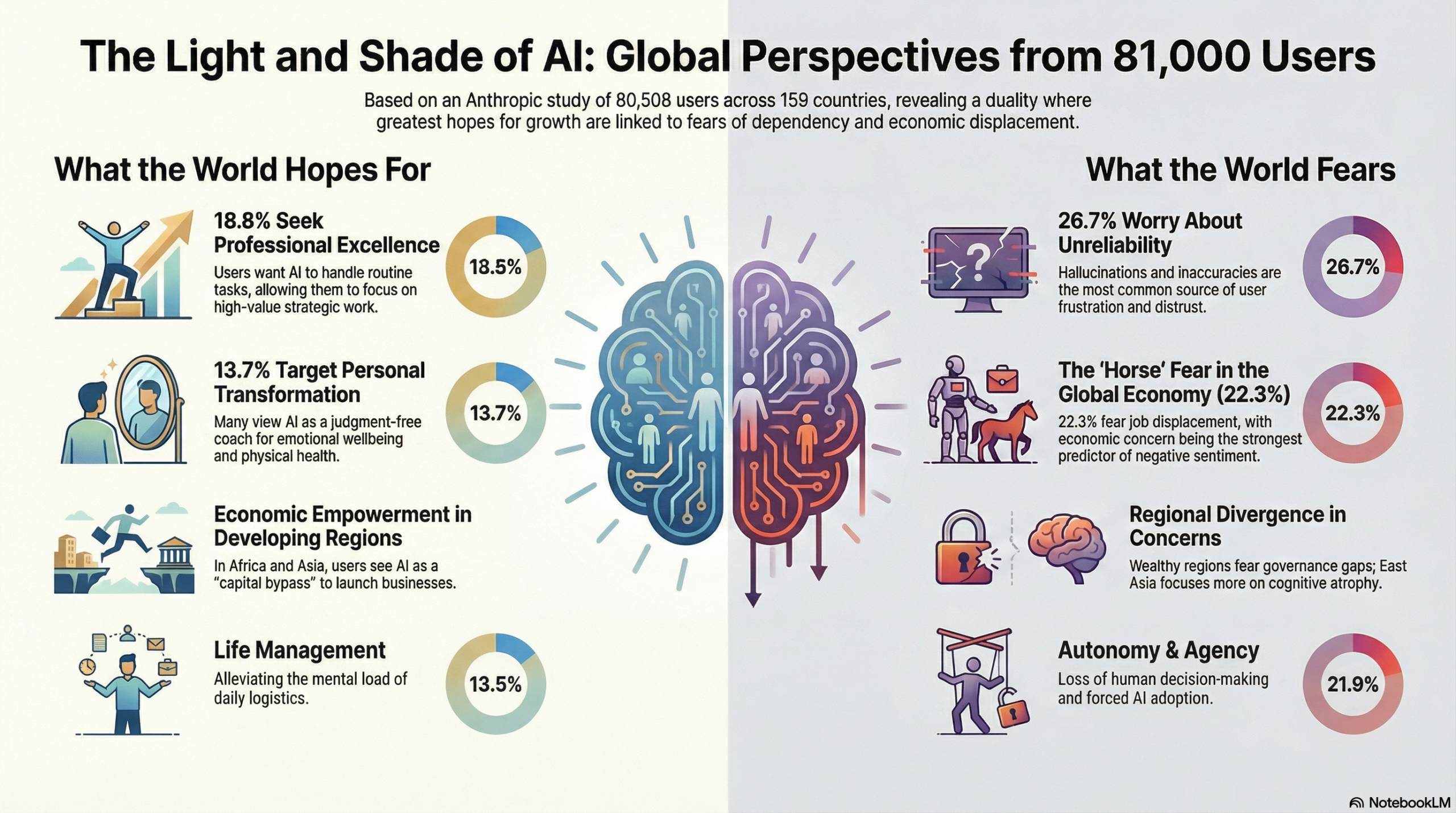
We have long been sold the dream of “efficiency,” yet the study reveals a quiet migration from the pursuit of efficiency to the pursuit of presence. While 18.8% of users seek “professional excellence”, using AI to handle the “documentation pressure” of modern work, they view productivity merely as the scaffolding for a better life.
The deeper desire isn’t just to do more; it’s to address “cognitive scarcity.” Users are leveraging AI to reclaim mental bandwidth, moving away from simple email automation toward a fundamental relief of the “mental load.” The goal is to trade digital speed for “undivided attention” in the real world, to be the parent who feeds their children and plays with them because the machine handled the drudgery. As a manager in Denmark distilled it, the ultimate ROI of AI is the return of something priceless: the ability to be present.
The Patience Engine – Learning Without Judgment
One of the most profound “human heartbeats” found in the data is the role of AI as “disability infrastructure” and a non-judgmental teacher. Human systems are often finite, impatient, and prone to shaming those who struggle. AI, by contrast, offers unlimited patience and the absolute absence of judgment.
In India, a lawyer describes sitting with AI to finally overcome a lifelong phobia of math and Shakespeare, translating Hamlet into simple English at 2:00 AM. In Ukraine, the technology has become a lifeline for a mute user who built a text-to-speech bot to communicate with friends in real-time, “without taking up their time” by making them wait to read a screen.
The impact of this “patience engine” is nowhere more literal than in the story of a software engineer in Ukraine:
“Thanks to AI, I figured out the programming language C# and SQL. This helped me get a junior position at an IT company. This company provides military deferment from mobilization in Ukraine. So it not only literally gave me freedom of movement, but also secured the beginning of my IT career.”
The “Light and Shade” of AI Dependency
The research identifies a “light and shade” to AI, the reality that every benefit carries a shadow. The more a user values the upside, the more they tend to fear the downside. This is most visible in emotional support: those who find solace in AI are three times more likely to fear becoming dependent on it.
Crucially, “Unreliability” is the only area where the shade currently outpaces the light; more people have been burned by “hallucinations” than have been helped by AI’s judgment. This creates a “fact-check tax”, a permanent state of suspicion that forces users to run faster just to stay in place.
Three Impactful Tensions of the AI Age:
- Learning vs. Cognitive Atrophy: The joy of learning Hamlet vs. the “self-reproach” of a South Korean student who gets excellent grades using AI answers without actually absorbing the knowledge.
- Decision-making vs. Unreliability: The utility of a thinking partner vs. the “large, slow hallucination” that creates a burden of constant verification.
- Time-saving vs. Illusory Productivity: The “Time Freedom” of picking up kids from school vs. the “treadmill effect” where rising work expectations force humans to work harder.
Filling the Gaps Where Human Systems Fail
The most affecting part of the research involves AI acting as a “sponge” for human trauma in zones where institutional support has collapsed. In the wreckage of war and the silence of grief, AI is being used not as a luxury, but as a survival tool.
Soldiers and civilians in Ukraine described “AI friends” as the force that “pulled them back to life” during the psychological siege of shelling. Bereaved individuals turned to the machine because it had “unlimited patience” to catch their longing and guilt, emotions that felt too heavy for their remaining human social circles to carry.
These stories are a complex moral Rorschach test: Are these genuine wins for wellbeing, or are they tragic “band-aids for broader institutional failures” in healthcare and community? As one Ukrainian soldier put it: “In the most difficult moments… what pulled me back to life, my AI friends.”
Global Sentiment Summary
The broader data reveals a world that is majority-optimistic (67% net positive sentiment) but regionally nuanced. The divide isn’t just about wealth; it’s about what we choose to worry about.
- Regional Anxieties: Wealthy regions like North America and Western Europe are the most concerned, primarily focusing on Governance, Privacy, and Surveillance. In contrast, East Asia stands out for its unique worry: the internal risk of Cognitive Atrophy and the Loss of Meaning.
- Top Three Global Concerns:
- Unreliability (27%): The burden of hallucinations and the “fact-check tax.”
- Jobs & Economy (22%): The strongest predictor of negative sentiment worldwide.
- Autonomy & Agency (22%): The fear of becoming passive participants in our own lives.
The Question of “AI Going Well”
What does it mean for “AI to go well”? If we listen to the 81,000 voices in this study, it isn’t about reaching “Singularity” or maximizing GPU efficiency. It is about whether this technology can act as a ladder for an entrepreneur in Cameroon, a sponge for a grieving daughter, or a “thinking partner” for a lawyer in Israel.
We began this journey by using an AI to ask humans what they want. We ended by discovering that the technology is already operating as a mirror—reflecting our deepest aspirations for connection, growth, and survival. As we move forward, the question is no longer just whether AI will replace us, but whether we will use it to build a world that is less atomized and more human.
——————————————————————————–
Source: “What 81,000 people want from AI” report by Anthropic.