The global conversation is saturated with the promise of Artificial Intelligence. From boardrooms to government halls, nations are in a frantic race to harness its power. While many countries are still debating strategy, Thailand has moved decisively from abstract ambition to concrete action, launching a comprehensive national plan to embed AI into the very fabric of its economy and society.
This is not just another tech policy document. It is a blueprint for a nationwide transformation, backed by massive investment and astonishingly specific goals. This article unpacks the most impactful and surprising takeaways from Thailand’s detailed AI and digital transformation strategy, revealing a plan that is as much about people and ethics as it is about technology.
1. The Sheer Scale of Ambition: A Multi-Billion Baht National Overhaul
Thailand’s government has made its intentions clear: it aims to develop the nation into a regional AI hub and fundamentally enhance national competitiveness. This objective is backed by staggering financial commitments that signal a top-down national priority.
The strategy is underpinned by a massive estimated 500 billion baht for broad digital infrastructure, sourced from public and private sectors. Within this, a targeted THB25 billion plan is set to fast-track specific AI development over the next two fiscal years. This public commitment is validated by significant private investment, most notably AWS’s pledge of 190 billion baht over 15 years to build out the nation’s cloud backbone. This layered investment leaves no doubt about the seriousness of the country’s AI ambitions.
2. It’s a People-Powered Revolution, Not Just a Technological One
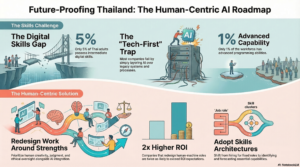
Beyond the massive infrastructure spending, the most striking element of Thailand’s strategy is its profound focus on human capital. The plan recognizes that technology is useless without a population skilled enough to use it. To that end, the government has set specific, highly ambitious targets for workforce development.
The goal is to train “at least 10 million people as AI users, 90,000 as AI professionals, and 50,000 as AI developers within the next two years.” This represents a dramatic acceleration from the initial 2022-2027 plan, which aimed to create “more than 30,000 AI talents within 6 years.” This counter-intuitive, people-first approach is a critical part of the strategy, ensuring that the country builds the necessary skills to fully leverage its technological investments.
2. It’s a People-Powered Revolution, Not Just a Technological One
Beyond the massive infrastructure spending, the most striking element of Thailand’s strategy is its profound focus on human capital. The plan recognizes that technology is useless without a population skilled enough to use it. To that end, the government has set specific, highly ambitious targets for workforce development.
The goal is to train “at least 10 million people as AI users, 90,000 as AI professionals, and 50,000 as AI developers within the next two years.” This represents a dramatic acceleration from the initial 2022-2027 plan, which aimed to create “more than 30,000 AI talents within 6 years.” This counter-intuitive, people-first approach is a critical part of the strategy, ensuring that the country builds the necessary skills to fully leverage its technological investments.
4. AI Is Already Here, And It’s Improving Lives
While the strategy outlines a future vision, its principles are already delivering tangible results in Thailand’s public sector. These real-world applications demonstrate the practical value of AI in enhancing citizen-centric services and moving the initiative beyond mere planning documents.
Public Safety: An AI-powered policing system deployed during the Songkran festival increased arrest-warrant detections by 30 percent and reduced incidents by 20 percent.
Education: At Chulalongkorn University, an automated essay-scoring system has reduced grading time by 45 percent, freeing educators to focus on personalized student feedback.
Healthcare: The “Health Link” data platform now connects over 900 hospitals and 4,500 community facilities, empowering citizens by putting their personal health records directly into their hands.
Mental Health: The DMIND AI voicebot, integrated into the national 1323 mental health hotline, has handled over 560,000 interactions, reducing caller wait times by 60 percent and decreasing dropped calls by more than half.
5. Putting Ethics and Governance First
In the global rush to adopt AI, ethics and regulation can often become an afterthought. Thailand’s plan distinguishes itself by explicitly prioritizing them from the outset. This “ethics-first” approach is a surprisingly mature and crucial element for building long-term public trust.
The very first pillar, “Strategy 1” of the Thailand National AI Strategy, is dedicated to “Preparing Thailand’s readiness in social, ethics, law, and regulation for AI application.” This isn’t just a mission statement; it’s tied to a measurable goal of ensuring “At least 600,000 Thai population have awareness of AI law and ethics.” By tackling governance head-on, the strategy aims to ensure that the benefits of AI are distributed equitably and responsibly across all of society.
Conclusion: A Holistic Blueprint for the Future?
Thailand’s AI strategy is noteworthy not just for its scale, but for its comprehensive and balanced approach. It masterfully blends massive investment in hard infrastructure with ambitious goals for human development, a foundational focus on digital public infrastructure, and an unwavering commitment to an ethical framework.
It avoids the trap of a purely technology-centric view, instead creating a holistic plan centered on people, services, and trust. As nations worldwide grapple with the promise and peril of AI, could Thailand’s balanced and holistic blueprint become a model for building a truly inclusive and responsible digital future?