The Growth Treadmill vs. The Growth Machine
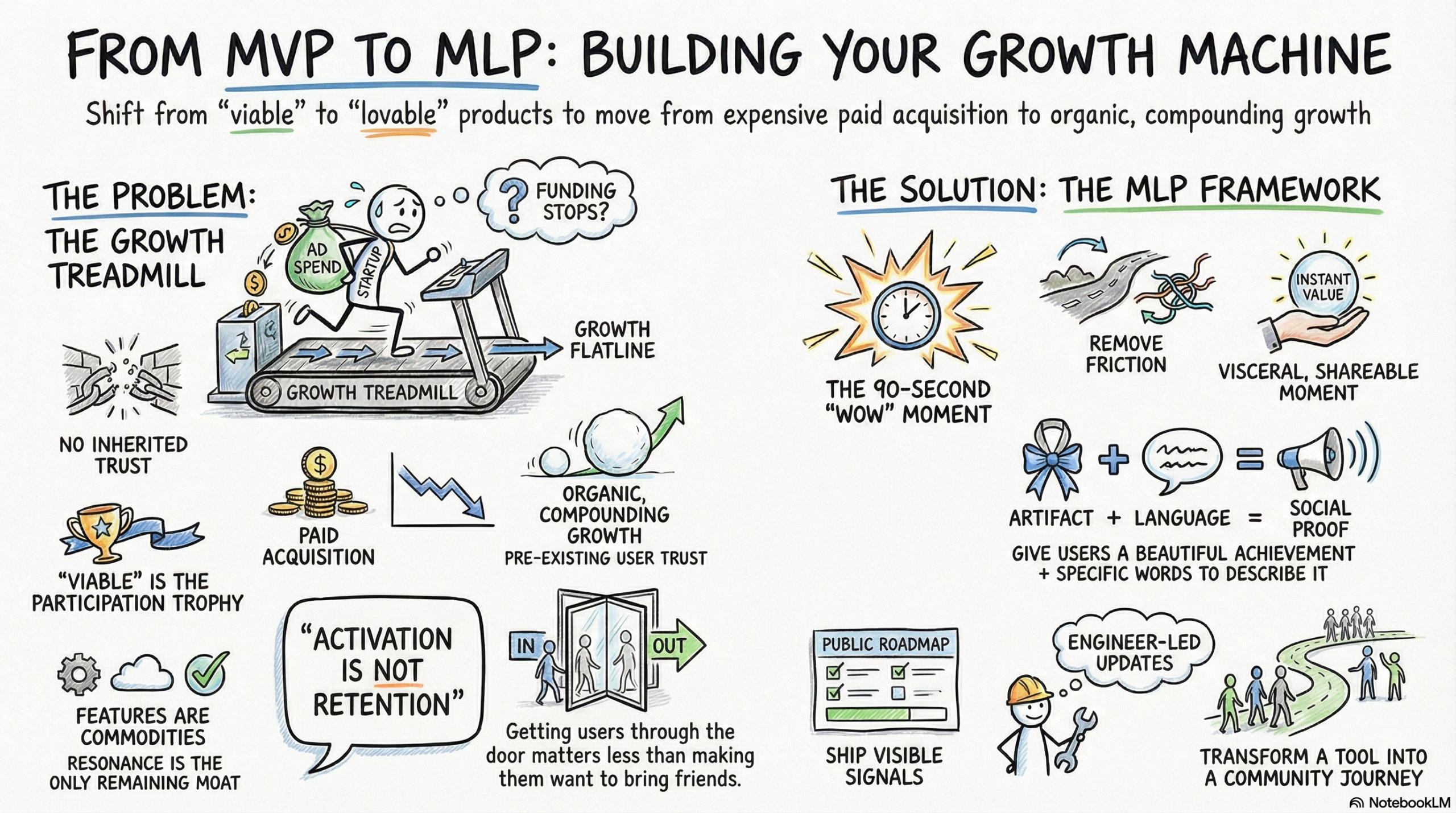
Modern founders are bleeding capital on a growth treadmill. You spend to acquire, you spend to retain, and you spend again to re-engage. The moment the funding dries up or the ad spend stops, the growth flatlines. This isn’t just exhausting; in the current market, it is a death sentence.
The alternative is a growth machine where word-of-mouth drives compounding interest. When a product spreads itself, every dollar saved on advertising transforms into runway. You don’t fight for attention, you inherit it through pre-existing trust.
As we navigate 2025, the landscape has fundamentally shifted. We are in the era of “vibe-coding,” where AI allows competitors to replicate your “unique” features in a single weekend. In a world where features are commodities, your only remaining moat is resonance. To survive, you must abandon the Minimum Viable Product (MVP) and build a Minimum Lovable Product (MLP).
Takeaway 1: Forget MVP, Build for Maximum Resonance
The 2015 startup playbook is dead. In that era, you built for “viability” and then used paid acquisition to force growth. Today, “viable” is the baseline, it’s the participation trophy of the SaaS world.
The new standard is the MLP philosophy, exemplified by companies like Lovable. They reached $200M in annual recurring revenue in under a year with a team of only 100 people. They didn’t achieve this through hyper-optimized funnels or aggressive SEO; they achieved it because users were obsessed with the experience.
Most founders miss this shift for four specific reasons:
- They mistake activation for retention: Getting a user through the door isn’t success; making them want to bring a friend is.
- They treat launch as a finish line: They ship and move on, whereas lovable products maintain a constant pulse.
- They rely on outdated distribution: Paid ads and SEO are losing ground to community and social resonance.
- They build in private: They hide their process and announce with “big drops,” missing the chance to build a tribe during the build.
As the source context highlights:
“Getting someone through the door is not the same as making them want to come back, or bring a friend.”
Takeaway 2: The 90-Second “Wow” Moment
Your job is to engineer a peak moment. It must be visceral. It must be instant.
Ask yourself: what would make someone pull out their phone and show the person sitting next to them? That is your MLP’s North Star.
Stop making users wade through onboarding. Kill the friction.
Remove every single step between signup and the “Wow.”
In the Lovable ecosystem, that moment is non-negotiable. A user types a prompt and sees a fully functional, working app appear in 90 seconds. That isn’t a feature; it is a calculated design decision intended to manufacture magic. If your product takes twenty minutes to provide value, you have already lost.
Takeaway 3: Turn Users into Heroes with Social Proof Loops
Standard notifications are noise. To build a machine, you need social proof loops. This requires a sophisticated synthesis of Step 2 (The Artifact) and Step 3 (The Language) of the MLP framework.
First, your product must automatically generate an Artifact. Think Spotify Wrapped, GitHub contribution graphs, or Strava routes. These work because they aren’t about the product, they are about the user’s achievement. The product is merely the vehicle that makes the user look like a hero.
However, an Artifact is useless if the user doesn’t know how to talk about it. You must provide the Language.
- Default to shareable outputs: Make the results of your product public and beautiful by default.
- Build referral momentum: Integrate sharing into the natural flow of the product, not as a desperate “invite friends” pop-up.
- The One-Liner: Give users the exact words to describe their achievement.
When you provide the evidence of success (the Artifact) and the words to describe it (the Language), you turn every user into a voluntary distributor.
Takeaway 4: Ship Visible Signals, Not Silent Updates
A lovable product is a living thing. Products that generate compounding word-of-mouth don’t just “launch”, they keep happening. They maintain a constant pulse that gives users a reason to check back in and share updates every single week.
This doesn’t require a massive marketing department. It requires the discipline of shipping visible signals:
- Public Progress: Share rough builds and design decisions mid-process.
- Visible Changes: Ship small, tangible updates consistently rather than silent “bug fixes.”
- The Engineer’s Voice: The most successful founders today have their engineers announce their own updates.
This transparency transforms a product from a static tool into a community journey. When users feel like they are part of the building process, they don’t just use the product, they defend it. Community isn’t just a buzzword; it is the ultimate distribution channel.
Conclusion: The MLP Bet
The difference between a growth treadmill and a growth machine is the difference between spending to acquire and engineering to compound. On a treadmill, your growth stops the second you stop paying. In a machine, every user makes the next user more likely to join, and every share reduces your cost per acquisition.
The winners in 2025 aren’t the ones with the most funding. They are the ones with the highest standard for maximum resonance. They understand that the MLP isn’t about minimum effort, it’s about creating something people love enough to talk about.
Look at your current roadmap. Is there anything on it that a user would actually feel compelled to show a friend? If the answer is no, you aren’t building a machine. You’re just building a faster treadmill.