The Great AI Misconception
Everyone thinks the best AI adopters will win. They’re wrong.
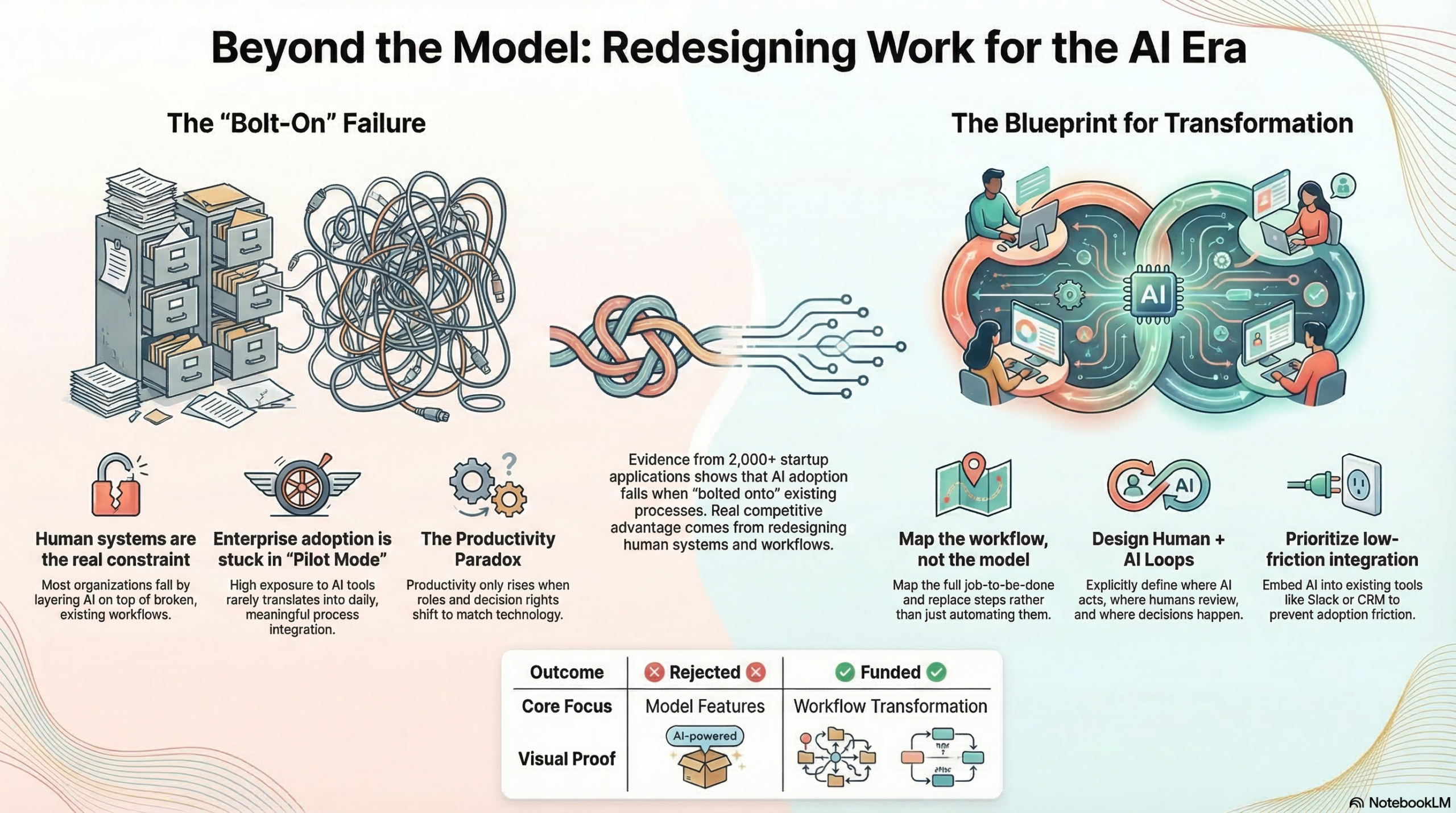
After 15 years operating across Southeast Asia in digital transformation, I’ve seen this movie before. The prevailing belief, that gaining early access to the “best” model is the ultimate advantage, is a fundamental misunderstanding of how value is created. I’ve learned that AI capability isn’t the constraint. Human systems are. The winners of this shift won’t be the ones with the most powerful API keys; they will be the ones who fundamentally redesign how work gets done.
Takeaway 1: The Productivity Paradox Redux
We are witnessing the “Productivity Paradox” in real-time. This occurs when technology moves at lightning speed while institutions remain stagnant. It’s why enterprise AI adoption is currently stuck in “pilot mode.”
Most organizations are making the classic mistake of “bolting” AI onto existing, broken processes. They run experiments and launch internal pilots, but nothing actually changes. Data from Microsoft, Anthropic, and McKinsey shows a massive gap between high AI exposure and low daily integration. Why? Because productivity gains only appear when roles and decision rights shift. If you simply give a broken process an AI tool, you don’t get efficiency, you just get faster garbage. Technology consistently moves faster than institutions, and institutional inertia is what kills ROI.
Takeaway 2: The Shift in Human Value (Systems over Tasks)
The job market is already reflecting this systemic friction. While entry-level roles that focus on isolated execution are shrinking, demand is exploding for “system redesigners.” These are the operators who can manage complex AI workflows and integrate these tools into the core of the business. The ability to manage a process is no longer enough; the new essential skill set is the ability to rebuild the workflow itself. Human value is shifting from the completion of tasks to the architecture of systems.
### Your Competitive Edge Isn’t the Model
Using a specific model from OpenAI, Anthropic, or Google is not a moat. These models are commodities; they are available to everyone, including your competitors.
“Your competitive edge isn’t the model you use. It’s how you rebuild the workflow around it.”
Translation for founders: Your product is not the AI. Your product is the rebuilt workflow. If you aren’t changing the way work happens, you aren’t building a business; you’re just renting someone else’s intelligence.
Takeaway 4: The Funded vs. The Rejected (The “Wrapper” Trap)
In my world, the divide between success and failure is clear. I see founders pitch “AI-powered” solutions every day that are nothing more than thin “wrappers” over existing models. I reject these in under 5 minutes.
The startups that get funded are those that prove the system itself has changed. They don’t just talk about features; they show me a definitive before-and-after workflow. To secure capital and close deals, you must meet these six criteria:
- Start with the workflow, not the model: Map the full “job-to-be-done.” Replace steps entirely rather than just automating them.
- Solve a painful task: Target a clear bottleneck. If you aren’t saving immediate time, money, or eliminating errors, you aren’t a priority.
- Design human + AI loops: Be explicit. Define where the AI acts, where the human reviews, and where the final decision happens.
- Measure real outcomes: Track hours saved and revenue gained. Vanity metrics don’t close deals in a tight market.
- Integrate into existing tools: Fit into Slack, CRMs, and ERPs. Friction kills adoption, and forcing new habits is a losing battle.
- Sell transformation, not features: Show how the workflow changes. Focus on the result of the systemic shift, not what the model can do.
Takeaway 5: Why Most Will Fail (And Why That Is Your Opportunity)
The bottom line is that AI won’t transform work by itself. It is a catalyst, but humans must be the architects of the change. Most organizations won’t do this. They will stay trapped in the inertia of “how we’ve always done it,” layering new tech over old problems until they become irrelevant.
Most won’t redesign. That is your opportunity. The failure of the majority to adapt creates a massive opening for those willing to rebuild from the ground up.
Conclusion: A New Blueprint for Work
AI is not a software update; it is a fundamental shift in the architecture of work. It won’t transform your business automatically. You have to be intentional about the redesign. The future belongs to those who stop looking for a magic wand in a new model and start looking for a new blueprint for their operations.
The Question for You: Are you paying for AI seats to do old work, or are you ready to fire your current processes and build something better?