The Hidden Paradox of Progress
Thailand is currently navigating a high-stakes paradox where rapid AI adoption masks a fragile foundation of human readiness. While “digital transformation” dominates C-suite agendas, the reality is that technology is a commodity, whereas human potential remains a bottleneck. For the strategic leader, the goal isn’t just to install better software, but to unlock the distinct capabilities that a machine simply cannot replicate.
The 5% Reality Check: Thailand’s Digital Skill Gap
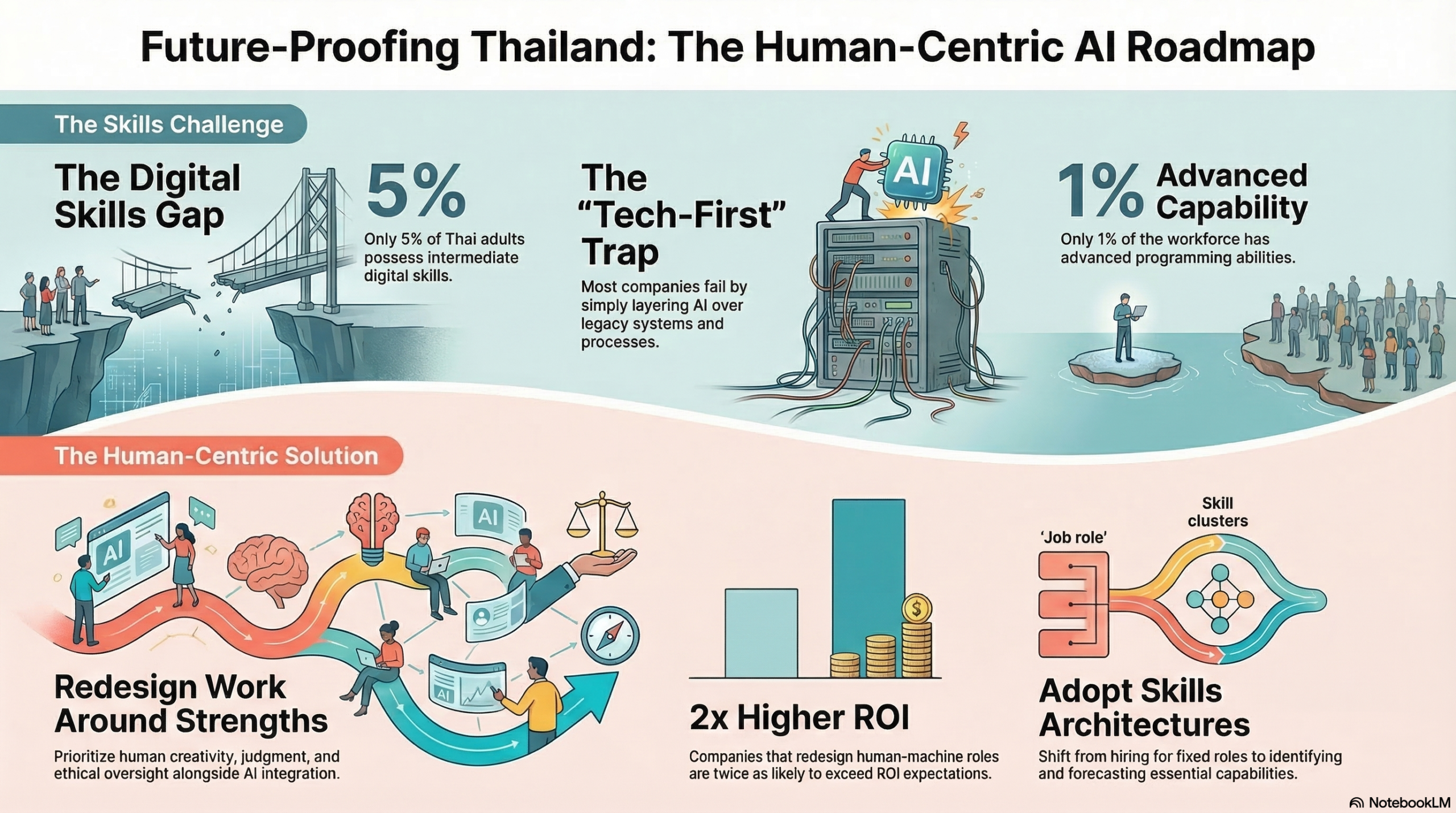
The World Bank’s latest figures serve as a cold shower for Thailand’s digital dreams. Currently, only 5% of Thai adults possess intermediate digital skills, while a vanishingly small 1% have advanced programming abilities. This gap is more than a statistic; it is a structural risk that threatens to stall national ambitions, from digital transformation to the critical green transition.
Simply buying more tech won’t bridge this chasm. Without a drastic upgrade in human proficiency, the most expensive systems will fail to deliver value. For Thailand to move beyond being a consumer of tech and instead leapfrog into more advanced value chains, the investment must shift from the hardware to the heads of the workforce.
The 2x ROI Secret: Redesigning Roles, Not Just Systems
Most organizations fall into the trap of “layering” AI on top of legacy processes, effectively putting a jet engine on a horse-drawn carriage. Research from Deloitte reveals a far more lucrative path: companies that fundamentally redesign human and machine roles are twice as likely to exceed their return on investment (ROI) expectations.
This success isn’t about automation for its own sake. It is about rethinking the synergy between man and machine to ensure that technology enhances, rather than merely replaces, the human element. The organizations winning this race are the ones looking at work through a lens of total role reinvention.
Human Strengths as the New North Star
As AI commoditizes routine data processing, the premium on human judgment, creativity, and ethical oversight has never been higher. The objective is a “human-centered” approach where technology is the tool, not the master. This shift requires creating environments where people can develop skills that complement, rather than compete with, technology.
“The Thai organisations that will thrive are those that can redesign work around human strengths while integrating AI and emerging technologies.” – Ariya Phukfon, Technology and Transformation Leader at Deloitte Thailand.
From “Fixed Roles” to “Skills Architectures”
The era of the static, linear career path is dead. Deloitte suggests that leading organizations are now pivoting toward building “skills architectures,” which prioritize outcomes and skills over mere task-based outputs. In this fluid model, talent is no longer tethered to a single department but can move entrepreneurially across the business as needs evolve.
By focusing on outcomes rather than just the volume of work produced, companies can stay agile in the face of constant disruption. This skills-based approach allows a workforce to remain relevant even as specific job titles become obsolete, transforming the workforce into a resilient, adaptive engine.
The Talent Magnet: What Gen Z and Millennials Actually Want
Sustaining long-term growth requires winning the war for the next generation of talent. According to the Global Gen Z and Millennial Survey 2025, young professionals are no longer satisfied with just a paycheck; they are looking for a culture of growth. Their top priorities include:
- Clear and rapid pathways for career progression.
- Consistent, accessible, and high-quality learning opportunities.
- The chance to engage in socially and professionally meaningful work.
Nisakorn Songmanee, Talent Leader at Deloitte Thailand, notes that investing in these specific areas is no longer an HR luxury, it is a necessity for navigating industry disruption and maintaining a competitive edge.
Conclusion: The Strategic Growth Imperative
Human capital is no longer a support function; it is Thailand’s most decisive strategic advantage. Future-proofing an organization is not just about talent retention, but a strategic growth imperative that determines who will lead the next economic era. If we can successfully redesign work around human strengths, we do more than just survive disruption, we capture the full opportunity of the AI economy.
As you evaluate your own roadmap, the question is no longer about which software to buy next. The question is: Is your workforce currently competing with technology, or is it designed to complement it?