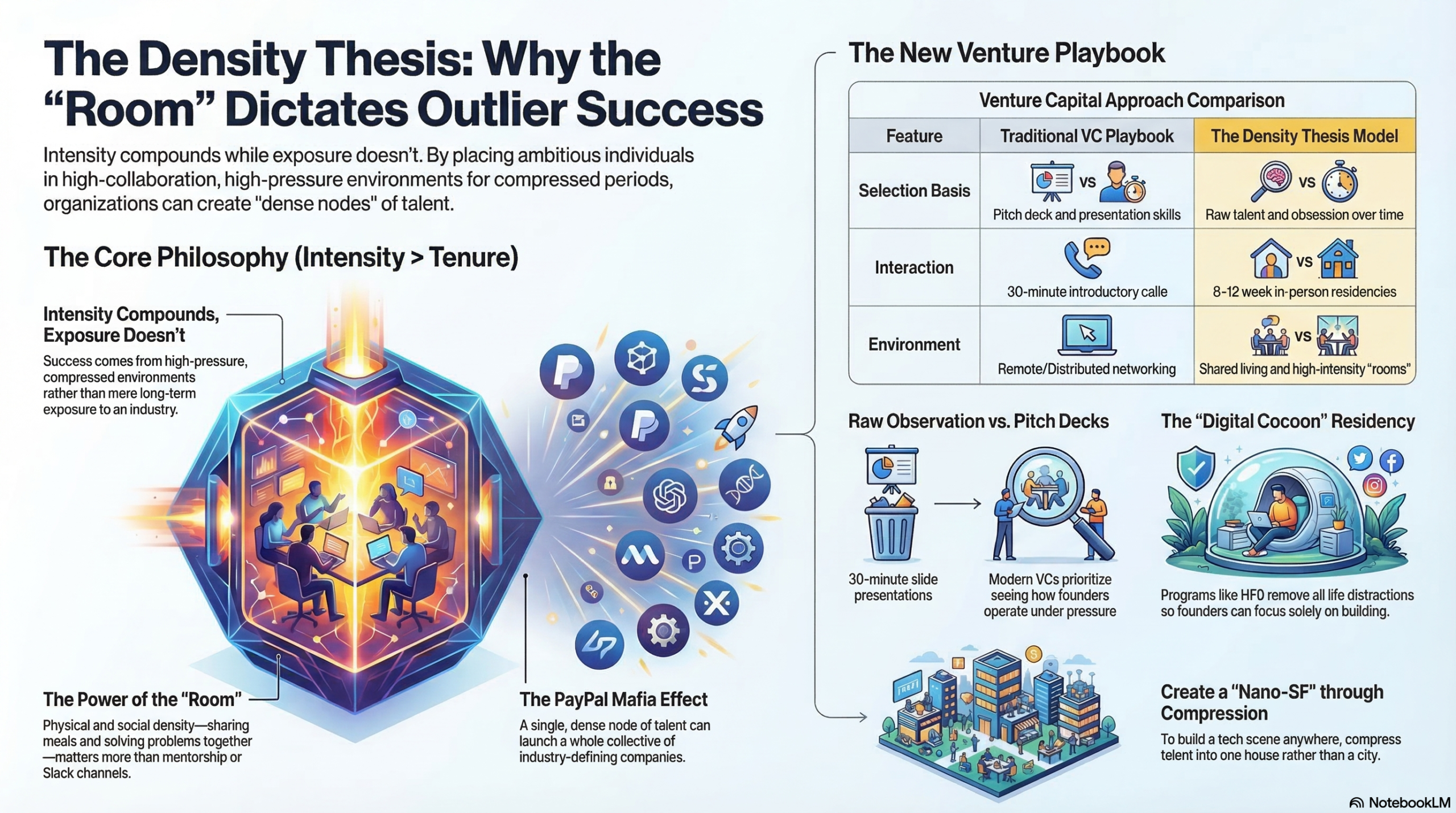
Alexander Hamilton famously obsessed over being in “the room where it happens,” yet it has taken the venture capital industry nearly 250 years to catch up to his intuition. For decades, we have been fed a diet of traditional hustle culture: the belief that success is a linear accumulation of hours worked and the breadth of a LinkedIn network. We are taught to collect “exposure” like digital trading cards, assuming that being adjacent to success will eventually cause it to rub off.
The reality is far more clinical and far more aggressive. This is “The Density Thesis”, the modern antidote to a venture playbook that has grown stale. The central argument is that your trajectory is not determined by your tenure or your talent in a vacuum, but by the physical and intellectual intensity of the room you inhabit. Success is not a marathon of endurance; it is a series of high-pressure compressions.
Intensity Compounds, Exposure Doesn’t
There is a hollow comfort in “exposure.” Professionals often move to specific zip codes or attend prestigious conferences under the guise of networking, but proximity is a passive state. You can stand in a room of giants and remain a dwarf if you are not locked in the same struggle.
The distinction is vital because of how the math of talent works. Consider the “PayPal Mafia.” This wasn’t just a collection of smart individuals; it was a dense node of outlier talent, Elon Musk, Peter Thiel, Reid Hoffman, compressed into a single, high-stakes environment. Their success was a collective explosion, not a series of individual sparks.
We see this same phenomenon in the talent-investing model of Entrepreneurs First (EF). In 2021, an EF cohort was placed in a room under extreme time constraints and forced to build. While many of the companies formed in that pressure cooker didn’t survive the year, the group chat did. The relationships, forged in a state of high-intensity collaboration, became more durable than the products they built.
“Intensity compounds. Exposure doesn’t.”
Moving Beyond the “VC Parody”
Traditional venture capital has devolved into a parody of efficiency. The standard operating procedure, a 30-minute Zoom call and a request for a 12-slide deck, is essentially a performance review for theater students. It relies on “pattern-matching on presentation skills,” an approach that systematically filters out the most interesting people.
The founders who build globally significant companies rarely fit into a tidy spreadsheet or a standard TAM calculation. They are often “weird about specific problems,” possessing an obsessive focus that feels like a glitch to a casual observer. You cannot spot this weirdness on a slide deck. You identify it through “non-pitch time”, unscripted hours where you see how a founder thinks when the script runs out. This is why the market is shifting: the only way to find the outliers is to get in the room and stay there until the performance ends.
Intensity Over Tenure: The Value of Shared Pressure
The tech world is finally realizing what the arts and elite sports have known for a century: density of experience changes people. Before they were household names, Ryan Gosling and Justin Timberlake were housemates; Ben Affleck and Matt Damon were writing in a shared apartment. They weren’t just friends; they were a dense node of ambition, providing the visceral data of shared struggle.
This is the failure of formal mentorship and “demo days.” They lack the raw, informal intensity required for transformation. True growth happens when you eat the same food, share the same frustrations, and watch how a peer operates when their idea breaks at 2:00 AM.
“The conversations that matter don’t happen on the agenda. They happen at the end of the day, when everyone’s guard is down.”
The Comfort Trap: Graduate Relentlessly
High-performers face a unique hazard: the comfort of being the smartest person in the room. The moment an environment becomes predictable, its density drops. To maintain a high trajectory, one must be a “relentless graduate,” pushing to the edges of a room and then leaving for a harder one as soon as the friction disappears.
This isn’t just a mindset; it is an engineering problem. In Dublin, a group of founders famously took over shared houses rather than traditional offices. They didn’t do this just to save on rent; they did it to attract talent by offering an environment of total immersion. They treated their “personal best” not as a plateau, but as a target to be broken, creating a mini-ecosystem where the standard for “enough” was constantly being redefined by the person in the next room.
Engineering the “Digital Cocoon”
We are seeing a formalization of this density through “engineered environments.” The Immersive Software Engineering degree at the University of Limerick, funded by the Collison brothers, is a prime example. It discards the traditional academic rhythm for a high-intensity professional mirror. Students spend half their time in the industry, their holidays are shortened, and the physical space is flipped: students stay put in their “room” while the lecturers come to them. It is a literal manifestation of the thesis—the room is the constant; the intensity is the variable.
In the startup world, HF0 takes this to its logical extreme. They provide a “digital cocoon”, twelve weeks in a single building with one-way glass walls and acoustic optimization. By removing every life distraction, laundry, meals, logistics, they compress the founder’s world until the only decision left is the work. Even a16z has pivoted toward this with the Alpha Fellowship, backing technical talent in person before a company or a pitch deck even exists. They are betting on the room before they bet on the product.
If You Can’t Find the Room, Build It (The Nano-SF Strategy)
The common rebuttal is geographical: I am not in San Francisco. But the lesson of the Density Thesis is that if you cannot find the center of the universe, you must build it. This is the “Nano-SF” strategy.
Innovation doesn’t happen by spreading talent across a city and hoping for “serendipitous collisions.” It happens through compression. If you are in a tech desert, your only chance is to make your immediate space, your house, your small office, your group chat, the center of the universe. Ten people in a single house with an obsessive focus will always outperform a thousand people in a loose network.
The Final Trajectory
The era of “what you know” is being replaced by an era defined by “who you are compressed with.” We are moving toward a world where the node is more valuable than the individual.
The trajectory of your career will not be found in your resume. It will be found in the intensity of your peer group. The market is finally catching up to the power of the room, but the responsibility to enter it, or to build it from scratch, remains yours.
Ask yourself: Is the room you are in today pushing you to your edges, or has it become a comfortable place to hide? Your answer is the only data point that matters.