The Invisible Failure
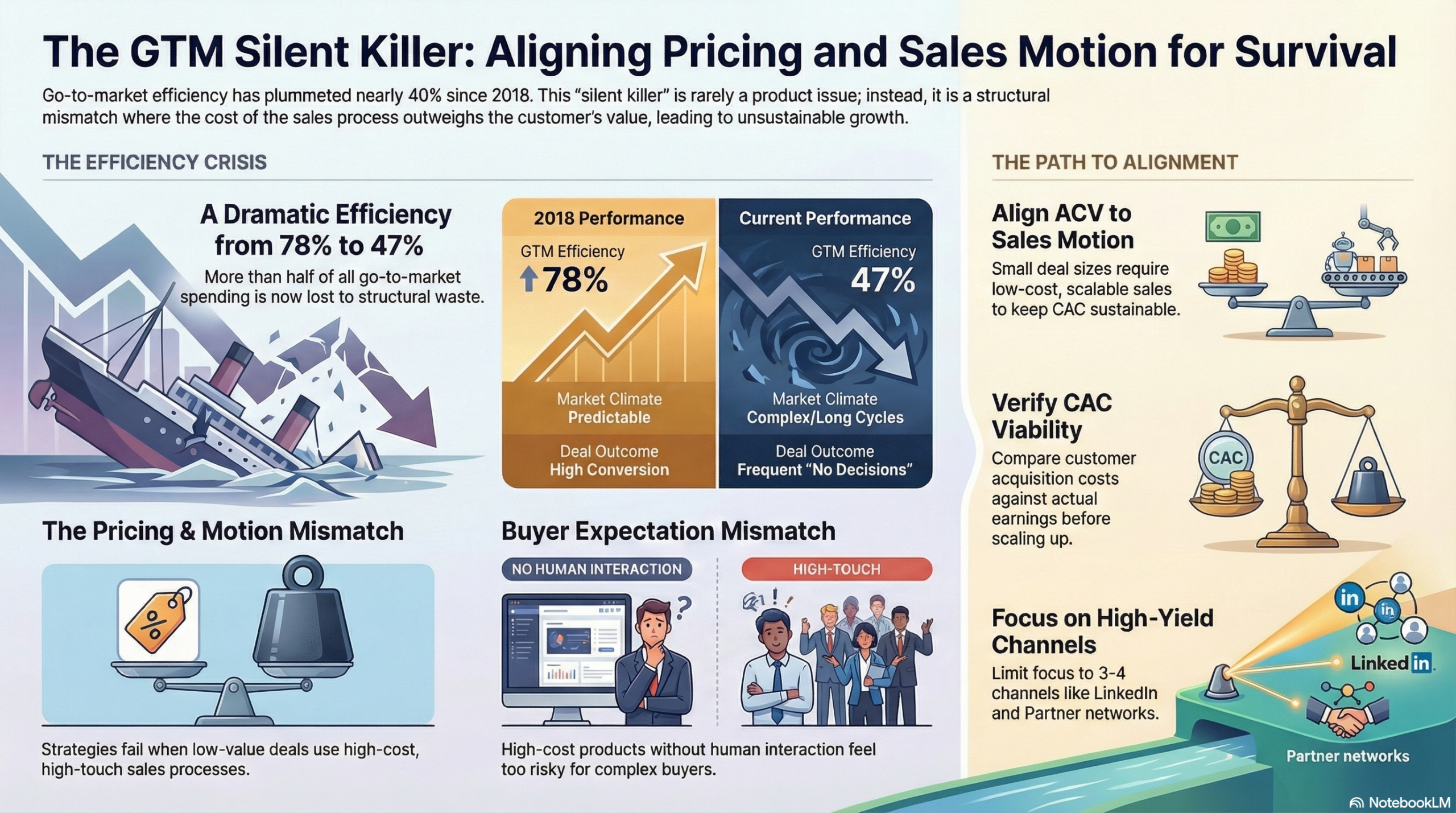
In 2018, go-to-market (GTM) efficiency stood at a robust 78%. Today, that figure has collapsed to a staggering 47%. This is the “Silent Killer” of the modern startup: a structural decay in how companies reach their customers that drains capital faster than any product flaw ever could. While founders obsess over product-market fit, the reality is that more than half of every dollar spent on sales and marketing is now disappearing into a void of structural waste.
The 47% Reality: A Structural Collapse
This precipitous drop from 78% to 47% is not a reflection of poor effort or talent; it is evidence of a fundamental market shift. The landscape has grown hostile to traditional tactics as buyers have become more complex and decision cycles have stretched to historic lengths.
This is a structural collapse, not a team failure.
The symptom of this collapse is the “no decision” outcome. Pipelines may look healthy, but deals are increasingly evaporating into thin air because the structure of the sale no longer aligns with the reality of the buyer. When your GTM motion is out of sync with the market, you aren’t just being inefficient, you are building a system designed to fail.
The ACV Paradox: Why Your Pricing is Killing Your Sales
The most uncomfortable truth in SaaS today is that most GTM strategies fail before execution even begins. The cause is a lethal misalignment between Average Contract Value (ACV) and the sales motion. Founders often treat pricing as a secondary concern, but in reality, your pricing dictates your destiny.
The mismatch manifests in two lethal forms:
- The High-Touch Trap: Deploying expensive, human-intensive sales teams to chase small deal sizes. The unit economics simply never clear the hurdle of sustainability.
- The Self-Serve Gap: Attempting to close complex, high-six-figure enterprise deals through a low-touch or automated process. The buyer, lacking guidance, views the transaction as too dangerous to approve.
“Your ACV decides how you should sell.”
If your pricing and your sales motion are not in lockstep, your Customer Acquisition Cost (CAC) will become an unsustainable anchor. You may see growth in the short term, but it is a hollow victory, you are merely burning capital to buy a future you cannot afford.
The Psychology of the Purchase: Matching the Buyer’s Vibe
A “good product” is powerless against a friction-filled buying experience. Deals often end in “no decision” because the sales motion creates a psychological mismatch. When you sell a low-cost product through a heavy, multi-stage sales process, the experience feels agonizingly slow and bureaucratic to the buyer. Conversely, attempting to sell a high-ticket enterprise solution without human interaction feels incredibly risky.
In both scenarios, the buyer defaults to doing nothing. This is not a messaging problem or a product gap; it is a motion problem. If the “vibe” of the purchase doesn’t match the price point, the deal will go cold for no apparent reason.
Less is More: The Power of Channel Pruning
The era of “omnichannel” desperation is over. Spreading a lean team across every available marketing channel is a recipe for mediocrity and wasted spend. The most successful organizations are doing less, better, pruning their focus down to just three or four high-impact channels.
The data is clear on where that focus should land for B2B:
- LinkedIn: Currently the top-performing channel for B2B engagement and lead generation.
- Partner Channels: The fastest-growing avenue for efficient, trust-based scaling.
By cutting secondary channels, you stop the dilution of your GTM efforts and allow your team to master the platforms that actually move the needle.
Survival of the Leanest: Are You Default Alive?
GTM efficiency is no longer a metric for the boardroom to monitor; it is a binary indicator of survival. Calculating your CAC viability is not an exercise for a later stage—it is a non-negotiable directive that must be addressed early. You must know exactly how much you can afford to spend to acquire a customer and ruthlessly compare that to your actual costs today.
Fixing a broken GTM motion is not an “optimization” task for middle management. It is a fundamental pivot that determines the fate of your company.
“Are you default alive or default dead?”
If your GTM efficiency is hovering at the industry average of 47%, you are building on a foundation that cannot sustain itself. In this environment, fixing your GTM is not about incremental improvement, it is about ensuring the business survives the night.
Conclusion: The Survival Audit
Sustainable growth is found only in the harmony between your pricing, your buyer’s expectations, and your sales motion. Without this alignment, your startup is not a business; it is a countdown.
If you audited your sales motion against your ACV today, would your growth look like a success, or a countdown to zero?