The sensation is visceral: a low-grade anxiety that an unstoppable train is hurtling toward you while you stand frozen on the tracks. Every morning brings a new model release, a billion-dollar funding round, or a “must-use” tool that promises to automate your career by lunch. This isn’t just “keeping up with the news”; it’s a state of paralysis.
But here is the truth: the feeling of being “behind” is a hallucination. The problem isn’t the technology, it’s the “Phase” you’re watching and the biological traps your brain has set to keep you safe. To move forward, you don’t need more news. You need to change your relationship with speed.
You’re Measuring the Wrong Speed (The Three Phase)
To understand why you feel stuck, you must recognize that “AI speed” is a lie. There isn’t one speed; there are three distinct phases, and they are out of sync.
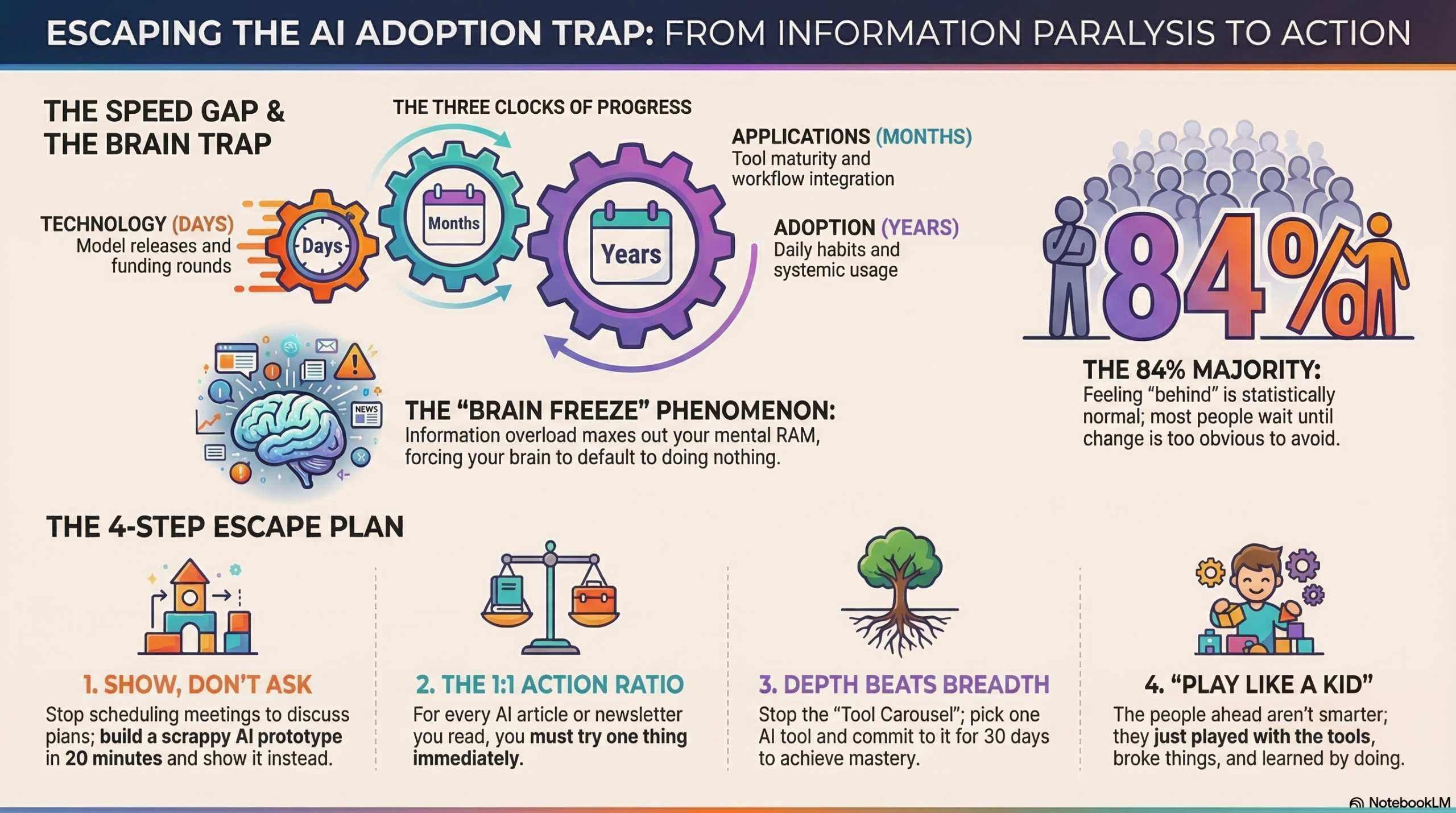
- Phase One: Technology (Days): This is the speed of research and model releases. It moves at a historical, unprecedented pace. This is the world of Twitter breakthroughs and daily “game-changers.”
- Phase Two: Applications (Months): This represents the tools you actually use. This clock moves much slower. Currently, most AI applications are half-baked, clunky, and poorly documented. They are messy workflows in search of a polished interface.
- Phase Three: Adoption (Years): This is the speed of human habit. History is a broken record of this lag. The iPhone launched in 2007, but mass daily adoption didn’t hit until 2012. Web browsers appeared in 1993, but the “average” person wasn’t online for everything until the mid-2000s.
Watching Phase One while trying to live on Phase Three creates a false sense of failure. You are comparing how fast you’re learning to how fast the world is adding data. It’s an impossible race.
The technology is genuinely moving faster than anything before it. Historical speed… But technology speed is not application speed. Application speed is not adoption speed. Adoption crawls behind.
Your Brain is Built for the Savanna, Not the GPT Era
Your paralysis is biological, not logical. Evolution spent millions of years teaching your brain that unfamiliar equals risky. In the AI era, that survival mechanism has become a prison.
- The RAM Problem (Cognitive Load): Think of your brain’s processing capacity as RAM. When you consume a flood of conflicting news and 50 new tool releases, your RAM maxes out.
- The Freeze Response: When the brain is overloaded, it does something predictable: it defaults to what it already knows. This triggers Status Quo Bias, a mechanism where we choose the “default option” 70% to 90% of the time to save energy.
The flood of AI news is literally freezing your brain. More information leads to more paralysis, which leads to less action. If you feel “behind,” you are likely in the 84% of the adoption curve that waits for things to become obvious. That is statistically normal, not a personal failing.
The Four Traps Keeping You Stuck
Most professionals are caught in behavioral loops that made sense in 2019 but are catastrophic in 2024.
Trap 1: The Permission Loop
We were trained to get buy-in and align stakeholders before moving. That made sense when building took months and mistakes were expensive. Today, you can build a prototype in twenty minutes.
- The Shift: Move from “asking first” to “showing first.”
- Reflection: In the AI era, waiting for permission is effectively choosing obsolescence over evidence.
Trap 2: The News Addiction
Reading about AI is not the same as using AI. Knowing about 200 tools while only using two (badly) is just “entertainment with anxiety.”
- The Shift: Prioritize action over consumption.
- Reflection: Information without action provides the illusion of growth while cementing your paralysis.
Trap 3: The Tool Carousel
Many users jump from ChatGPT to Claude to Perplexity, seeking a “perfect” tool that doesn’t exist yet. This results in surface-level mediocrity across all platforms.
- The Shift: Depth beats breadth. Master advanced features like Projects, Memory, or Custom Instructions on one platform.
- Reflection: Constant switching ensures you remain a perpetual beginner, never reaching the mastery that yields real results.
Trap 4: The Reflex Problem
The old wisdom was “measure twice, cut once.” But execution is now cheap. The bottleneck has moved from “making the thing” to “knowing what to build.”
- The Shift: Focus on clarity and speed of feedback over polished planning.
- Reflection: Your professional reflexes are calibrated for a world where execution was hard; now, your speed of feedback is what determines your value.
The “Start This Week” Protocol
Velocity is the only protection. To escape the traps, you need a high-velocity, scrappy protocol:
- Show, Don’t Ask: Build the scrappy AI first draft before the meeting. Show the client or boss what is possible rather than discussing what might be possible.
- One Article, One Action: Commit to the trade. For every piece of AI content you consume, try one thing immediately. If you read a prompt tip, run it now.
- The 30-Day Commitment: Pick one tool. Ignore all other announcements for a month. Go deep into the “how” of that specific ecosystem.
- The Mirror Principle: Stop asking AI to be your teacher; use it as a mirror. Use it for tasks you already master so you can supervise the output. AI should work under your eye to spot the “generic and soulless” errors it inevitably makes.
Reclaiming Your Inner Child (Play as Strategy)
Adults study technology. Children play with it. In a world of shifting sand, the “experts” aren’t the ones with the best degrees—they are the ones who played more. Mastery doesn’t come from a course; it comes from “doing it wrong” until it clicks.
“The people who seem ahead aren’t smarter… They just played more. They opened the tool more often. They tried dumb things. They broke stuff… They felt stupid and kept going anyway. They figured it out by doing it wrong.”
Reframing the Chaos
You are not slow. You are operating on a human timeline. The fix isn’t “catching up” to the news; it’s narrowing your focus until the noise disappears.
To reclaim your momentum, commit to the “Personal Fix”:
- One tool (Pick your primary AI).
- One hour (Dedicated daily time).
- One task (A specific, tangible goal).
- One ugly attempt (The ultimate antidote to perfectionism paralysis).
If you stopped watching the technology clock and started playing with the tools you already have, how much further could you go by this time next week?