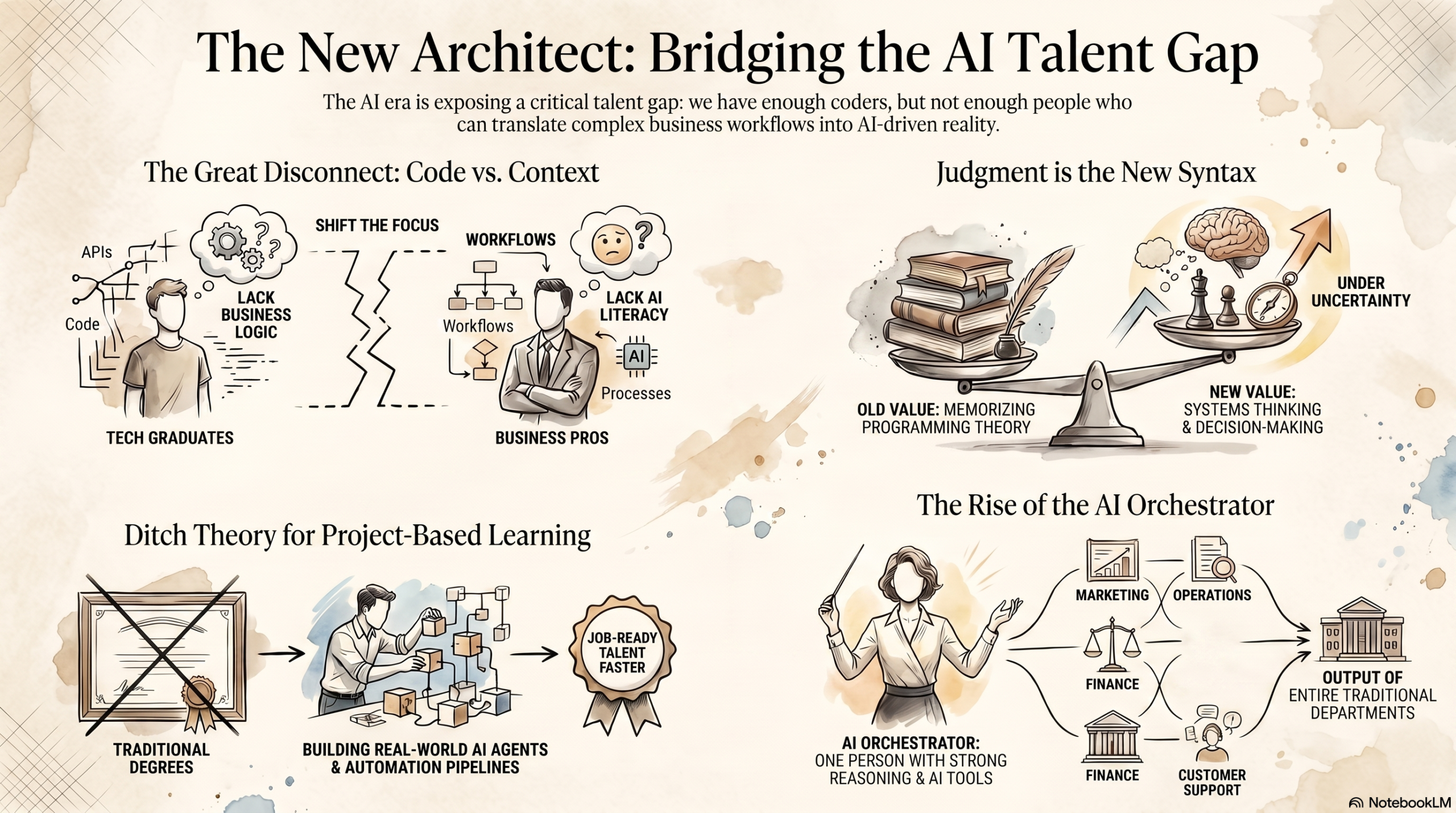
The global conversation around Artificial Intelligence has shifted. We are no longer merely discussing the potential of automation; we are witnessing a fundamental restructuring of the professional world. For universities and fresh graduates, this shift represents a “talent pipeline gap” where traditional technical skills, once the gold standard, are being superseded by a need for high-level judgment and workflow design.
The reality is that the shortage of AI talent is no longer just about a lack of programmers. Instead, the modern economy is desperate for individuals who can bridge the gap between technical possibility and business reality. To survive and thrive, both educational institutions and the next generation of workers must look beyond coding theory and embrace a new paradigm of “AI orchestration.”
The Reality Check for Fresh Graduates: Beyond the Syntax
For years, a computer science degree or a business major was a relatively straightforward ticket to a middle-skill job. However, the AI era is exposing a significant disconnect. Many technology graduates today are proficient in “coding theory”, they can build APIs or CRUD (Create, Read, Update, Delete) applications, but they often lack the ability to think in terms of business process orchestration.
In a real-world context, such as in digital transformation, the challenge isn’t just buying a Large Language Model (LLM); it is understanding how that AI will reshape complex workflows like underwriting, fraud detection, or customer servicing. Fresh graduates are increasingly being hired not for their current technical stack, but for their ability to learn quickly, as frameworks that are relevant today may become obsolete within a year.
To prepare, graduates must shift their focus from “what” to “how” and “why.” The skills that are becoming “expensive” and highly sought after include:
- The ability to understand context and map complex problems.
- Systems thinking, viewing a business as a series of interconnected workflows rather than isolated tasks.
- Decision-making under uncertainty, where AI provides data but humans must provide the final judgment.
The Evolution of the University: From Memorization to Orchestration
While students must adapt, the burden of change also falls heavily on educational institutions. Many universities are still operating under “old paradigms” that prioritize programming syntax, academic algorithms, and individual assignments. In the AI economy, these are becoming commodities.
Knowledge is becoming increasingly cheap, but judgment and adaptability are becoming increasingly valuable. To remain relevant, universities must move toward a model of project-based learning. Real-world implementation is the best teacher; a student who builds an AI-driven document extraction system or a customer service chatbot often develops faster than one who only studies machine learning theory.
The curriculum of the future must prioritize:
- Multidisciplinary Problem Solving: Breaking down the silos between the technology world and the operational business world.
- Human-AI Collaboration: Teaching students how to work alongside AI tools rather than competing with them.
- Reasoning and Problem Decomposition: The ability to take a massive business challenge and break it into parts that can be automated or augmented by AI agents.
If universities fail to accelerate this adaptation, they risk creating a “massive skill mismatch” that could lead to the collapse of middle-skill jobs and increased productivity inequality.
The Rise of the AI Workflow Architect
As the workplace moves toward a new operating model, traditional job titles are giving way to new roles that reflect the “orchestration” mindset. Companies no longer just need software engineers; they need AI workflow architects, AI operations designers, and AI-driven business process strategists.
These roles require a unique blend of “strong business understanding” and “an automation mindset”. In this new structure, a single person with high-reasoning capabilities and AI orchestration skills may eventually produce the output that previously required multiple departments. This is why the private sector is increasingly taking over the role of educator, building internal AI academies and sandbox experimentation environments because they cannot wait for formal education systems to catch up.
Practical Steps for the Transition
For the fresh graduate looking to become “job-ready,” the path forward involves stepping outside the classroom. Many developers today find more value in GitHub, Discord communities, and open-source ecosystems than in traditional curricula.
To prepare for the future of work:
- Focus on Implementation: Build real projects that solve operational problems. Exposure to real business workflows is essential.
- Develop “Workflow Thinking”: Stop thinking about code in isolation and start thinking about how AI agents, LLMs, and vector databases work together to drive business impact.
- Embrace Experimentation: The AI era belongs to those who possess an “experimentation culture” and the “rapid adaptability” to pivot as technology evolves.
Conclusion: A New Way to Learn
The most important structural change we face is not simply adding “AI 101” to a university syllabus. It is a fundamental shift in how people learn altogether. We are moving away from a world of memorized theories and toward a world of systems thinking, judgment, and creativity.
The question for every student and educator today is simple: Are we preparing for the workforce of the past, or are we architecting the skills necessary to work alongside AI in the future?. The companies—and the individuals—who succeed will be those capable of building small, high-judgment teams augmented by the power of AI. The transition may be difficult, but the rewards for those who bridge the gap between technology and business will be extraordinary.