In the global venture theater, there is a persistent myth that capital is the primary protagonist. We are conditioned to believe that if we simply pour enough liquidity into an emerging market, innovation will inevitably scale, and prosperity will follow. In Bangladesh, however, this narrative is colliding with a sobering reality. Despite a surge of brilliant founders and a massive, digitally-native population, the bottleneck isn’t the size of the checks being written, it is the structural integrity of the vessels receiving them.
We must stop conflating a lack of funding with a lack of potential. While capital is the fuel, the “engine” of the Bangladeshi startup ecosystem is currently suffering from a readiness crisis. To build a sustainable venture landscape in South Asia, we must look past the funding fallacy and address the structural gaps that prevent smart ideas from becoming world-class institutions.
1. Capital is Necessary, but Insufficient: The Liability of Premature Scaling
It is a common refrain among entrepreneurs that “more capital” would solve their primary woes. While funding is undeniably difficult to secure in the current global macro environment, we must confront a counter-intuitive truth: for many startups, an influx of cash before they are structurally sound is a liability, not an asset.
When a startup lacks “ecosystem readiness,” capital acts as an accelerant for existing inefficiencies. This creates the “Readiness Gap.” If a founder secures a multi-million dollar Series A without robust internal systems, the pressure to deploy that capital often leads to premature scaling, hiring too fast, overspending on unoptimized customer acquisition, and neglecting unit economics.
In a fragile ecosystem, this leads to a “burn-to-death” scenario. The money demands growth, but without the operational “absorptive capacity” to handle that growth, the startup effectively suffocates under the weight of its own bank account. As a strategist, I see that the ability to absorb and deploy capital effectively is now a rarer commodity than the capital itself.
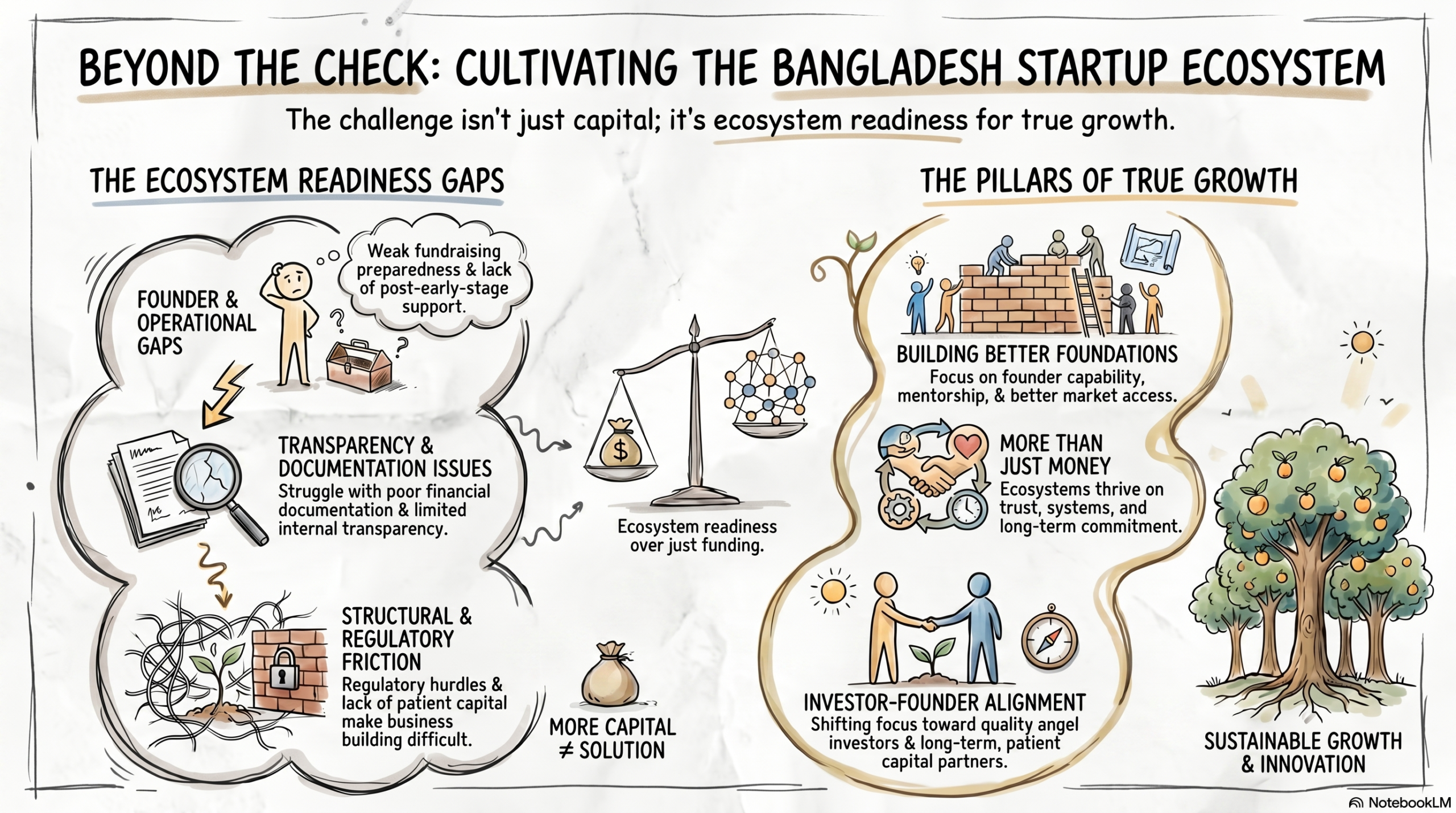
“The biggest challenge in Bangladesh’s startup ecosystem is not just capital. It is ecosystem readiness.”
True readiness means that when the wire transfer hits, the founder has the roadmap, the middle-management layer, and the internal governance to turn that investment into long-term value. Without this, capital is merely a temporary reprieve rather than a permanent catalyst.
2. The Transparency Trap and the Documentation Deficit
The internal readiness of a startup is often undermined by “boring” back-office failures. While founders in Dhaka are as visionary as those in Palo Alto or Bangalore, there is a recurring deficit in the administrative foundations required for world-class scaling.
Specific gaps that frequently emerge include:
- Weak founder preparedness for fundraising and scaling: Many founders treat fundraising as a pitch-deck exercise rather than a rigorous audit of their business’s scalability.
- The Ripple Effect: This results in “due diligence fatigue” where investors lose interest not because of the product, but because the founder cannot answer sophisticated questions about churn, LTV/CAC ratios, or cohort analysis.
- Poor financial documentation: Incomplete or disorganized records that prevent due diligence from progressing beyond a surface level.
- The Ripple Effect: This triggers a “Due Diligence Death Spiral.” Global VCs, who have limited time, will quickly pivot to other markets like Vietnam or Indonesia if a Bangladeshi startup cannot produce audited-grade financials in a timely manner.
- Limited transparency: A failure to provide clear insights into business operations or complex cap tables that hide potential liabilities.
- The Ripple Effect: This erodes the “Trust Premium.” When transparency is low, investors demand a “risk discount,” leading to lower valuations and more predatory terms for local founders.
This “Transparency Trap” is a silent killer. In a trust-deficient environment, documentation is the currency of trust. If a founder cannot demonstrate institutional-grade stewardship of their data, they will remain perpetually relegated to “friends and family” rounds, unable to tap into the global pools of capital required for regional dominance.
3. The Need for “Patient” Capital vs. Mercenary Capital
The Bangladeshi ecosystem currently suffers from a shortage of high-quality angel investors—those who provide more than just a transaction. We are seeing too much “Mercenary Capital”: money that seeks a 10x return in an unrealistic timeframe without providing any of the mentorship required to get there.
What the market desperately needs is “Patient Capital.” The difference is fundamental:
- Mercenary Capital focuses on the exit. It is transactional, short-term, and often flees at the first sign of regulatory or macroeconomic volatility.
- Patient Capital focuses on the infrastructure. It understands that in emerging markets, growth is non-linear. These investors act as “stewards,” helping founders navigate the “valleys of death” by offering mentorship and organizational systems.
Ecosystems do not thrive on deal volume alone; they grow through trust and long-term commitment. When the angel layer is composed of quality mentors who prioritize “cap-table hygiene” and governance over quick flips, the entire ecosystem’s reputation rises. Without this layer of patient, sophisticated capital, startups are often forced into bad deals that handicap their ability to raise follow-on rounds from global Tier-1 VCs.
4. The Post-Hype Support Vacuum
One of the most critical failures identified in the current landscape is the “Post-Hype Support Vacuum.” There is often a surge of excitement—a “hype cycle”—when a deal is signed. Press releases are distributed, and social media is abuzz. But once the initial check is deposited, the spotlight vanishes, and founders are frequently left to navigate the brutal complexities of scaling in isolation.
This vacuum exists because many local investors lack the operational experience to help a founder transition from a “product builder” to a “company builder.” Scaling a business is exponentially harder than starting one. Once a company moves past the seed stage, the challenges shift to organizational design, cross-border regulatory navigation, and talent acquisition systems.
The signaling effect of a check is a one-time event; the hard work of board governance is a five-to-ten-year commitment. To solve this, we must shift our focus from merely “funding startups” to “building support infrastructure.” This means creating a network of operators and advisors who provide shared services—legal, HR, and tech architecture—allowing the founder to focus on their core value proposition.
5. Structural Friction and the “Friction-to-Scale” Ratio
Beyond the internal struggles of the startup lies the external environment. “Regulatory friction” remains a primary inhibitor of growth in Bangladesh. Whether it is the complexity of repatriating funds, the lack of clear digital banking frameworks, or the bureaucratic hurdles of company registration, business building is fundamentally harder than it should be.
This creates a prohibitively high “friction-to-scale” ratio. When a founder has to spend 40% of their cognitive energy fighting structural friction rather than building their product, their path to becoming “world-class” is artificially hindered.
This has a devastating ripple effect on the “Brain Gain” dynamic. World-class Bangladeshi talent—engineers and executives currently at Google, Meta, or Grab—are hesitant to return home if they perceive the environment to be one of constant administrative resistance. To win, Bangladesh must not only produce talent but attract its global diaspora back. That won’t happen through patriotism alone; it requires an environment where the “ease of doing business” matches the speed of the digital economy.
6. Shifting the Conversation to Ecosystem Architecture
To move forward, the conversation in Bangladesh must undergo a fundamental shift. For too long, the primary question has been “How do we fund more startups?” This focus on transaction volume is a vanity metric. The more vital questions focus on the architecture of the ecosystem itself: How do we build better founders? How do we ensure institutional-grade governance?
“Ecosystems do not grow only through money. They grow through trust, capability, mentorship, systems, and long-term commitment.”
We must reframe our objectives toward long-term sustainability. The following comparison illustrates the necessary pivot in perspective for stakeholders:
| From: How do we fund? | To: How do we build? |
| Focus on transaction volume | Focus on founder capability and “better founders” |
| Focus on the size of the check | Focus on “better support infrastructure” |
| Focus on getting a deal done | Focus on “better investor-founder alignment” |
| Focus on the pitch | Focus on “better market access” and systems |
This transition from a funding-centric mindset to a building-centric mindset is the only way to ensure that the talent in the market reaches its full potential. If we continue to focus only on the “deal,” we will continue to see a high failure rate among funded companies. If we focus on the “architecture,” the funding will naturally follow.
Conclusion: Beyond the Hype
The outlook for Bangladesh remains grounded in optimism. The fundamental ingredients—unrelenting talent, massive demographic dividends, and high digital penetration—are undeniably present. The challenge is no longer about proving that Bangladesh can produce startups; it is about proving that it can sustain and scale them into regional champions.
The “real work” ahead is systemic. It involves moving beyond the dopamine hit of funding announcements and digging into the difficult, often invisible work of building trust, documentation, and mentorship. Capital is a coward; it only goes where it feels safe and where it can grow. By building “ecosystem readiness,” we create that safety.
The question for every stakeholder—whether you are a founder, an investor, or a policymaker—is no longer “Where is the money?” Instead, the question is: “What am I doing to build the support system that allows our founders to win at scale?” Only by answering that can we turn Bangladesh’s startup potential into a world-class reality.