In less than a thousand days, artificial intelligence has mutated from an experimental plaything into the foundational utility of the 21st century. We are no longer discussing “potential”; we are documenting a tectonic shift in how the global economy breathes. The “Microsoft AI Diffusion Report 2026-Q1” is not merely a data dump, it is a blueprint for an era where AI adoption is diversifying and disrupting specific economies with predatory velocity.
As a futurist, the most compelling question isn’t just about growth, but about agility. Why is the United Arab Emirates nearing total economic saturation while the United States, the supposed cradle of this revolution, is struggling to even break the top 20? The answers reveal a world where legacy infrastructure is a liability and “vibe coding” is the new literacy.
1. The 70% Saturation Point: The UAE’s Geopolitical Masterclass
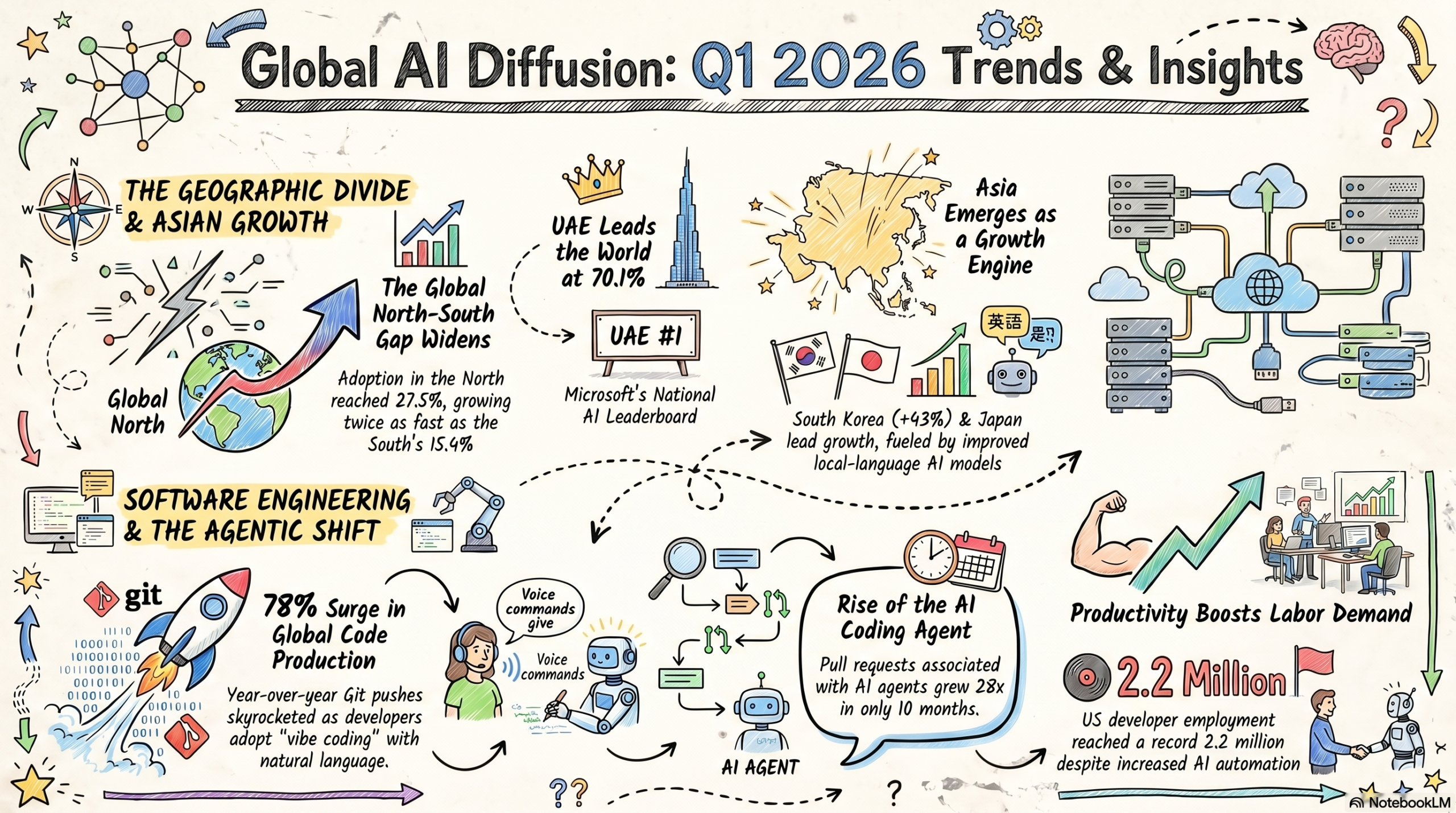
The most jarring revelation in the Q1 2026 data is the staggering lead of the United Arab Emirates. While the rest of the world debates ethics and implementation, the UAE has achieved a 70.1% AI usage rate among its working-age population.
This isn’t just adoption; it’s total integration. Compare this to the United States, which only recently clawed its way from 24th to 21st place with a 31.3% rate. While the U.S. remains bogged down by fragmented adoption and legacy systems, the UAE’s smaller, focused economy has enabled a top-down, high-velocity saturation.
The report is unequivocal about this dominance:
“At the top of Microsoft’s National AI Leaderboard, the UAE continued to lead global AI diffusion at 70.1%.”
2. Breaking the Language Barrier: The Asian Tectonic Shift
The most profound “step change” in this report isn’t found in Silicon Valley, but in the localized linguistic miracles occurring across Asia. We are witnessing a surge where AI is finally outperforming humans in their own native nuances.
The Localized Intelligence Explosion Japan’s AI adoption grew by 3.4 percentage points this quarter alone, a rate more than three times faster than the global average, contributing to a massive 34.1% increase since H1 2025. This isn’t accidental. It is the direct result of a “multilingual miracle.” For the first time in history, GPT-5 has achieved 87% accuracy in Japanese on the MMLU-Pro benchmark, actually exceeding its 85% score in English.
We see a similar pattern in South Korea, where usage skyrocketed by 6.4 percentage points this quarter (a 43% increase since June 2025). This explosion was ignited by the release of GPT-5, which proved substantially more capable in Korean than its predecessors. When AI masters the “local vibe,” diffusion ceases to be a slow climb and becomes a vertical takeoff.
3. “Vibe Coding” and the Decoupling of Human Effort
We are entering the era of “vibe coding”, a phenomenon that has fundamentally disrupted software production. Globally, Git pushes have accelerated by 78% year-over-year, and new repositories have increased by 45%. But the real story is in the agentic surge.
Vibe coding allows both veterans and novices to express complex architectural ideas in natural language, which AI then refines into shippable code. For the first time, code contributions are scaling without a proportional increase in human effort. Between June 2025 and March 2026, merged GitHub pull requests associated with AI coding agents grew more than 28x, exploding from 83,000 to 2.3 million in just ten months.
These aren’t just autocomplete tools. Agents powered by GPT-5.3-Codex are hitting 77% accuracy on Terminal-Bench and 65% on OSWorld, performing at professional engineering levels. Tools like Claude Opus 4.5 have moved from the sidelines to the center of the development lifecycle, acting as autonomous participants that handle debugging, testing, and UI refinement with minimal human oversight.
4. The Employment Paradox: Why Efficiency Breeds Demand
The most persistent fear of the AI era, mass technical unemployment, has been met with a counter-intuitive economic reality. As AI makes building software cheaper and faster, we aren’t seeing fewer developers; we are seeing more.
In 2025, U.S. software developer employment hit a record high of 2.2 million (up 8.5% YoY). By March 2026, the sector grew another 4% over the previous year. This “Employment Paradox” is driven by the Elasticity of Demand. When the cost of building software drops, organizations don’t just bank the savings; they respond by building more software for a wider range of use cases that were previously cost-prohibitive.
The report identifies this through the “productivity and reinstatement effects”:
“Technology can increase labor demand when it expands output and creates new tasks. In software, this mechanism is especially plausible because AI coding tools are already increasing developer output, while official labor projections continue to show strong growth in software-related roles.”
Essentially, AI has democratized creation so effectively that the world’s appetite for new digital solutions is growing faster than the AI can build them.
5. The Digital Divide: The Widening Chasm of the Global South
As a futurist, I must balance the “miracles” with a cautionary reality: the “AI gap” is no longer a crack; it is a canyon. While the Global North has reached 27.5% usage, the Global South sits at 15.4%.
More concerning is the velocity of the divergence. The North is growing twice as fast as the South (a 2.8 percentage point gain vs. 1.3). This divide is being cemented by three foundational constraints:
- Inconsistent access to electricity.
- Fragmented or non-existent internet connectivity.
- A critical deficit in basic digital literacy.
While “vibe coding” could theoretically democratize creation, it cannot function without power and a signal. Without deliberate global intervention, we risk a future where generative AI deepens existing inequalities rather than alleviating them.
Conclusion: The Practicality Phase
The Q1 2026 report confirms that we have exited the “hype cycle” and entered a phase of brutal practicality. AI is no longer a “feature”—it is the engine. From the saturation of the UAE to the 28x surge in agentic coding, the benefits of this era are spreading with unprecedented speed, yet they remain dangerously concentrated.
The ultimate question for the next decade is one of balance: Will the “vibe coding” revolution finally provide the tools to bridge the global divide, or will the infrastructure gap in the Global South leave half the world as permanent spectators to a history they are no longer permitted to write?