The Death of the Instinctual Click
For decades, digital strategy has been built on a single, reliable reflex: the instinctual click. If a user searched for your brand name or a specific product, Google acted as a high-speed transit hub, a mere pass-through on the way to your website.
However, a comprehensive analysis of 846,000 Google Search sessions from early 2026 reveals that the “pass-through” era is officially over. Google is no longer just a gateway; it has become the destination. The introduction of AI Overviews (AIO) has fundamentally disrupted the traditional search funnel, transforming what used to be a reflexive exit into a period of deep evaluation. Data suggests that search is shifting from a platform of discovery to a platform of deliberation.
The Engagement Equalizer: One Audience to Rule Them All
The study’s most profound finding for strategic planners is the “Engagement-Equalizer” effect. Historically, user behavior on Google was fragmented. A user looking for a quick brand login (Navigational) behaved nothing like a user researching a health condition (Informational).
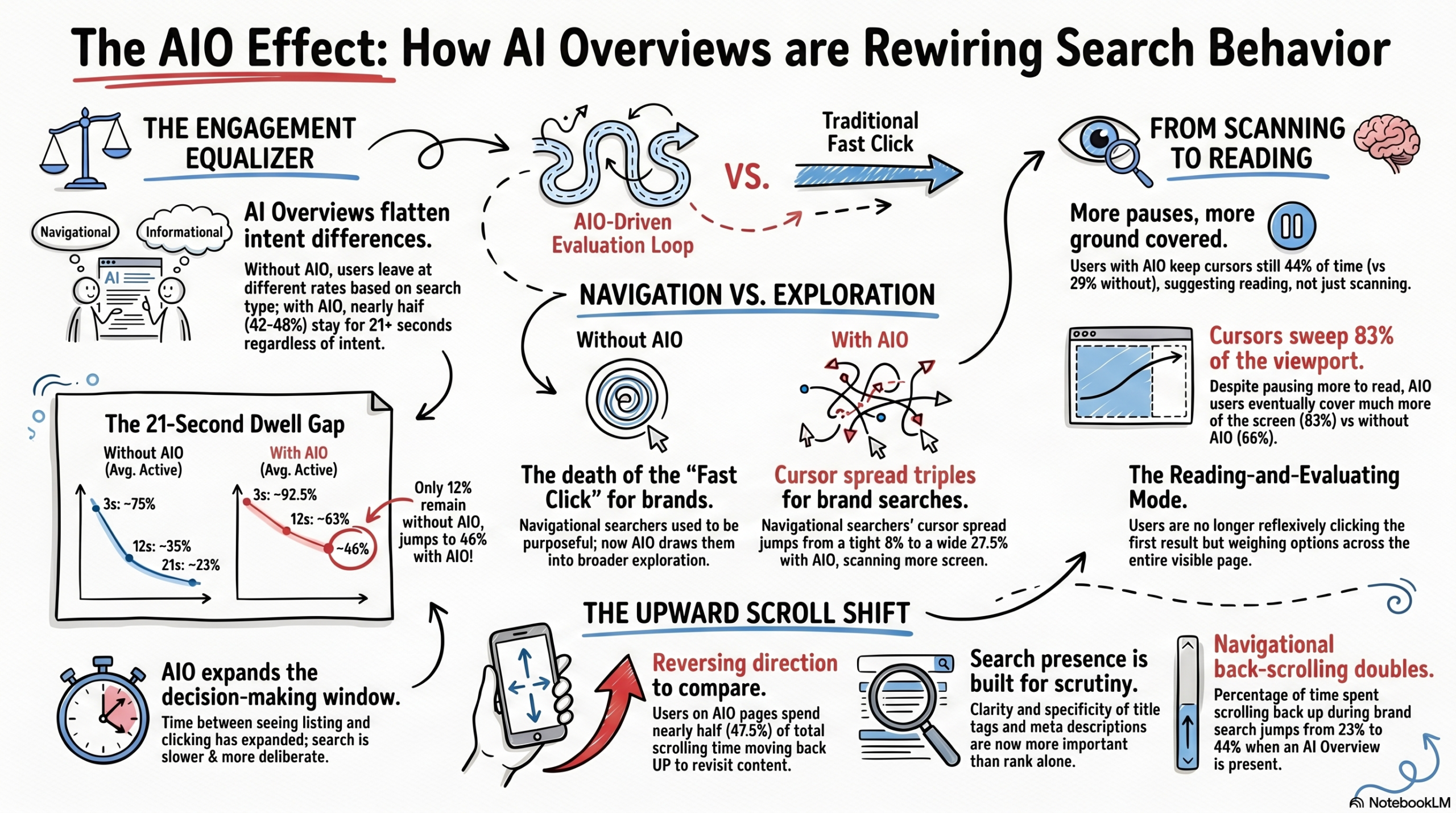
The presence of an AI Overview effectively collapses these distinctions. The engagement range across all intents narrows from a wide 12%–32% gap on standard pages to a tightly clustered 42%–49% on AIO pages. Whether the intent is transactional, local, or informational, Google now holds onto the user for an extended, uniform duration.
| Search Intent | Active Users at 21 Seconds (Without AIO) | Active Users at 21 Seconds (With AIO) |
| Informational | 21.6% | 45.4% |
| Local | 32.3% | 41.9% |
| Navigational | 12.0% | 45.8% |
| Transactional | 24.9% | 47.4% |
| Video | 23.4% | 48.5% |
Reflection: This represents a seismic collapse of the traditional marketing funnel on the SERP itself. The distinction between “Awareness” and “Intent” is being blurred by Google’s UI. We are no longer managing five distinct audiences; we are facing one unified, slower audience that requires a more sophisticated engagement strategy before they ever reach a landing page.
The Navigational Paradox: When Your Own Brand Name Isn’t Enough
The most alarming shift for brand owners is the “Navigational Searcher Transformation.” These are your most loyal or determined users, people typing your brand name directly into the search bar.
Historically, these users were the fastest to leave the SERP, with only 12% remaining after 21 seconds. In the AIO era, that number nearly quadruples to 46%. This “brand-interception” is forced exploration: the cursor spread for navigational searchers expands from a tight 8% (without AIO) to a broad 27.5% (with AIO). Even more telling, the rate of back-scrolling for brand searches nearly doubles, jumping from 23% to 44%. Your own brand-name search has become a competitive zone where users are distracted and diverted by AI-generated summaries.
From Scanning to Evaluating: The Rise of the “Cursor Pause”
The data reveals a fundamental pivot in cognitive processing on the screen. We have moved from a “scanning-and-clicking” environment to a “reading-and-evaluating” model.
When an AIO is present, cursors remain still 44% of the time, compared to 29% on traditional pages. Yet, during the time they do move, they cover 83% of the viewport, a significant increase from the 66% seen on standard pages.
“More pausing plus more ground covered suggests a reading-and-evaluating mode rather than a scanning-and-clicking mode.”
In this high-scrutiny environment, rank position is no longer the undisputed king. Because users are pausing to evaluate the AI’s summary against the organic listings, the quality of your search snippet is the new battleground. You aren’t just fighting for a click; you are providing a witness statement to a user who is actively cross-referencing your claims.
The U-Turn Effect: Why Users Are Scrolling Back Up
Search is no longer a one-way trip down the results page. The “Back-Scrolling” phenomenon has become a defining characteristic of the AI-driven SERP. While 51% of users on standard pages might reverse their scroll direction at some point, that frequency climbs to 59% when an AI Overview is present.
The intensity of this “U-Turn” is the real story. On pages with AI Overviews, the median user who reverses direction spends 47.5% of their total scrolling time going back up the page. Contrast this with the 27% baseline on pages without AIO. This isn’t accidental movement; it is a signal of active comparison. Users are scrolling down to see what the organic results offer, then returning to the top to re-evaluate the AI’s summary against those results.
The Business Impact: Winning the War of Scrutiny
For CMOs and business owners, the “War of Scrutiny” means that traffic is becoming more “considered” but significantly harder to earn. To survive, brands must treat the SERP as a conversion environment, not just a traffic source.
How to Leverage This Data:
- Conversion Rate Optimization (CRO) for the SERP: Your title tags and meta descriptions are no longer just “pitches”; they are evidence. Optimize snippets to provide specific, high-value data points that can withstand a 20-second evaluation period.
- Implement Snippet-Level Trust Signals: Use your search results to establish immediate authority. Since users are back-scrolling to compare you against the AI, your snippet must act as a “witness statement” that proves your relevance over the AI’s summary.
- Prepare for SERP-Based Comparison Shopping: Even for non-commodity brands, assume the user is comparing you to three other options before they click. Your search presence must be built for scrutiny, emphasizing clarity and differentiation.
- Content Depth as a Click-Reward: If a user spends 20 seconds deciding to click your link, they expect an immediate “depth-match” on the landing page. Ensure your content satisfies the high level of intent generated during the evaluation phase.
Conclusion: A New Search Reality
The 846,000-session study marks the end of the “reflexive click.” AI Overviews have prioritized clarity and deliberation over speed, expanding the decision window and forcing users to become active evaluators on the search page itself.
In this new reality, the digital landscape will favor brands that can capture and hold attention during the “cursor pause.” As the instinct to click fades and the habit of evaluation takes over, the question for every marketer remains: Is your search presence strong enough to win the war of scrutiny?